LiDAR Selection & Buying
LiDAR Sensor Wholesaler: Build a Lot Traceability File Before a Pilot Order
When an integration team receives a depth sensor sample, the urgent question is rarely “does it power on?” It is “can we connect this exact sample, its quoted configuration, its data behavior, and its bench results to a decision we can defend?” A lidar sensor wholesaler should be assessed with a small, practical evidence file—not only a catalogue page or a price conversation.
Quick answer
Before a pilot order, ask the source to link the quote and sample identity to the intended operating scene, interface, data type, laser-class statement, acceptance test, and change-contact path. Keep those records with the bench results. That gives procurement and engineering a common decision file and prevents a sample from becoming an untraceable one-off.
Why a lidar sensor wholesaler needs an evidence trail
A sample can be technically interesting and still be a poor decision input. A buyer needs to know what was requested, which physical unit was received, what software or interface route was used, which scene was tested, and whether the result applies to the next order. That does not require a supplier to disclose confidential manufacturing data. It does require the buyer to preserve the information that makes a pilot result intelligible later.
This approach is consistent with current procurement and traceability guidance. NIST SP 1326 describes acquisition-time due diligence around supplier and product information. NIST IR 8536 explains the value of a linked, time-ordered provenance record while allowing selective disclosure. For a LiDAR pilot, a spreadsheet or controlled project folder is enough if each record can be found and understood.
Think of the file as a chain with four links: requirement → quote/sample identity → bench evidence → integration decision. If any link is missing, pause before treating the result as purchasing evidence.
Lot-to-integration decision chart
| Decision gate | Ask the source for | Record internally | Do not conclude yet |
|---|---|---|---|
| 1. Fit the use case | Documented range, field of view, data outputs, interfaces, and stated application fit | Target, distance band, lighting condition, platform, and failure consequence | That a published range guarantees your real scene |
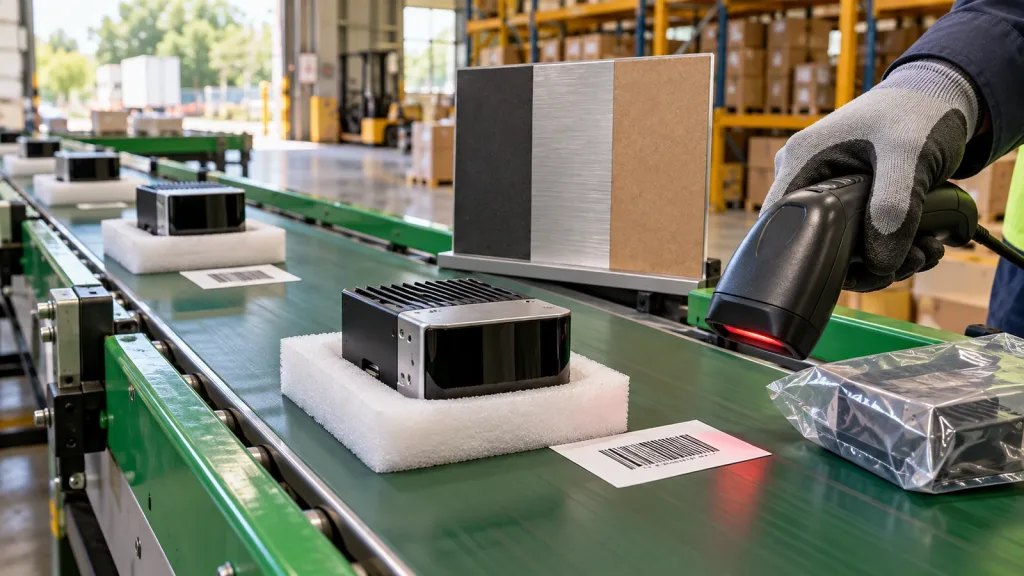
| 2. Identify the sample | Quote reference, product/model identity, supplied revision or version details when available, and a route for change notices | Receiving date, physical label/photos, quote, packing record, and project owner | That every later delivery is identical to an unrecorded sample |
| 3. Define the data handoff | Interface documentation, data format guidance, host requirements, and the support route | Host OS, interface selected, capture settings, raw files, parser version, and observed behavior | That the sensor alone supplies planning or safety logic |
| 4. Run the bench acceptance | Any available setup notes and declared operating limits | Mount, power arrangement, test targets, ambient conditions, pass/fail criteria, and anomalies | That one successful static test validates flight or production use |
| 5. Approve the next action | RFQ, sample or project-specific quote contact | Open risks, evidence gaps, approver, and next pilot scope | That a sample approval is a blanket production approval |
The ISO/IAF guidance on external providers similarly starts with clear purchase requirements and asks buyers to consider component risk and controls before order confirmation. Use that as a process cue, not as a claim that any particular supplier is certified or approved.
A documented product reference for the decision file
The following is an exact reference summary for the available Featured product, the MRP-LD1 Drone LiDAR Sensor. It is a starting point for a request and a bench plan, not proof that the module will meet an untested installation.
| Documented field | MRP-LD1 value | Buyer file prompt |
|---|---|---|
| Architecture | Solid-state SPAD dToF LiDAR; 940 nm VCSEL | Record the model named on the quote and retain the supplied product documentation. |
| Ranging baseline | 0.5–25 m indoors; 0.2–8 m outdoors | Define target material, angle, ambient light, motion, and the distance band your pilot will actually test. |
| Field of view and output | 60° horizontal × 45° vertical; 40 × 30 resolution at 10 fps; depth images and 3D point-cloud data | Map coverage and data cadence to the host-side decision the system must make. |
| Interfaces | UART, UVC, UDP | Name the chosen interface, host, capture tool, data record, and recovery path for a failed capture. |
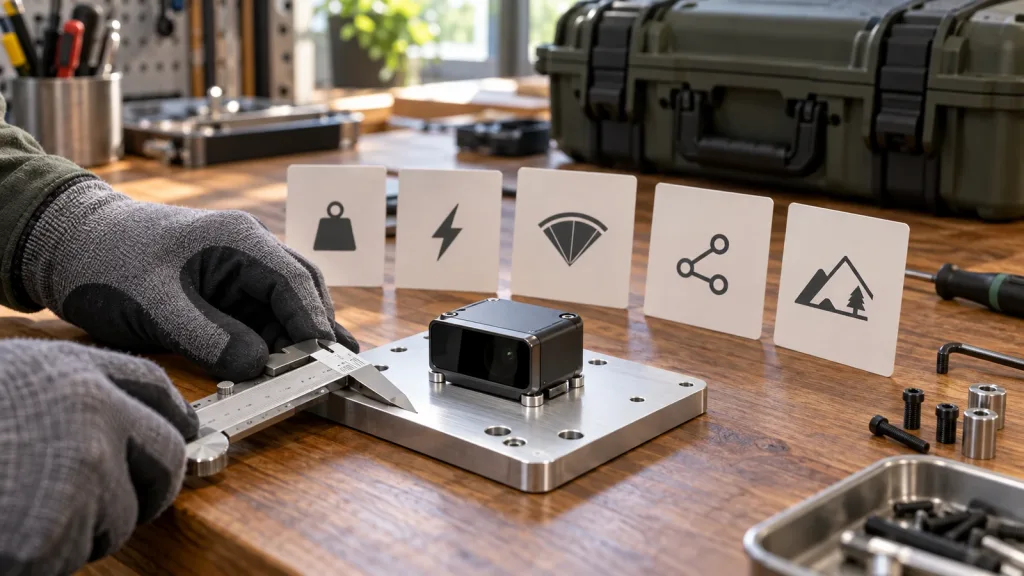
| Integration envelope | 8 g, 1.2 W, 5 V; software support listed for Windows, ARM, Linux, and Android | Check the actual mount, power budget, cable route, host OS, and thermal environment rather than copying values into a requirement. |
| Laser statement | Documented Class 1 laser-safety rating | Retain the supplier statement and review final-equipment obligations with the team responsible for the complete product. |
Laser classification is not a substitute for final-system review. IEC 60825-1 describes a laser-product classification framework and notes that a component sold for incorporation can have different scope considerations from the final product. Read the applicable IEC 60825-1 material and obtain qualified compliance advice for the market and finished equipment at issue.
Application case: receiving a sensor for an AMR aisle pilot
Imagine a robotics integrator evaluating a compact depth module for an AMR that must recognize an aisle-end obstruction. The team does not start by asking whether the catalogue says “robot navigation.” It defines the aisle width, the target types, the working distances, the mounting location, the required response owner, and the host platform. It then sends those requirements with the RFQ.
When the sample arrives, receiving attaches the quote reference and delivery record to the pilot folder. The bench engineer records the sample label, mount, power arrangement, chosen interface, raw captures, and target setup. If the team chooses the MRP-LD1 reference, it can evaluate the documented depth and point-cloud outputs through UART, UVC, or UDP against its host plan. The integrator, not the sensor, remains responsible for the perception logic, planning, controller behavior, and validation of the complete machine.
At the decision review, a result is useful only if its conditions travel with it. “Detected a carton” is not enough. “Sample associated with quote X, mounted at Y, captured through interface Z, against target A at distance B under condition C” gives the next engineer a reproducible question to investigate.
Interface and data handoff: questions to settle before the sample ships
A product listing can name interfaces without resolving how your host will use them. For a lidar sensor wholesaler conversation, ask which interface you intend to evaluate and make the answer part of the pilot request:
- UART: What host voltage, serial settings, packet reference, and capture method will the team use?
- UVC: Which host and capture application will record the test, and which output mode is needed for the pilot question?
- UDP: What network path, receiver, packet capture, and timestamp handling will be used?
- Depth and point cloud: What is the acceptance artifact—raw frames, parsed values, a geometry check, or a host-side decision log?
- Change control: Who receives a question if documentation, sample behavior, or the planned configuration no longer match?
For host-side preparation, compare this decision file with the site's Windows and Linux SDK validation guide. For the physical scene, the indoor/outdoor range validation guide is a useful reminder to test the actual target and environment.
Five common mistakes when buying through a LiDAR source
- Comparing prices before defining the test. A cheaper sample is not comparable if the team has not agreed on target, geometry, data route, and acceptance evidence.
- Letting the sample lose its identity. A bench result becomes weak when no one can reconnect it to the quote, received item, and configuration used.
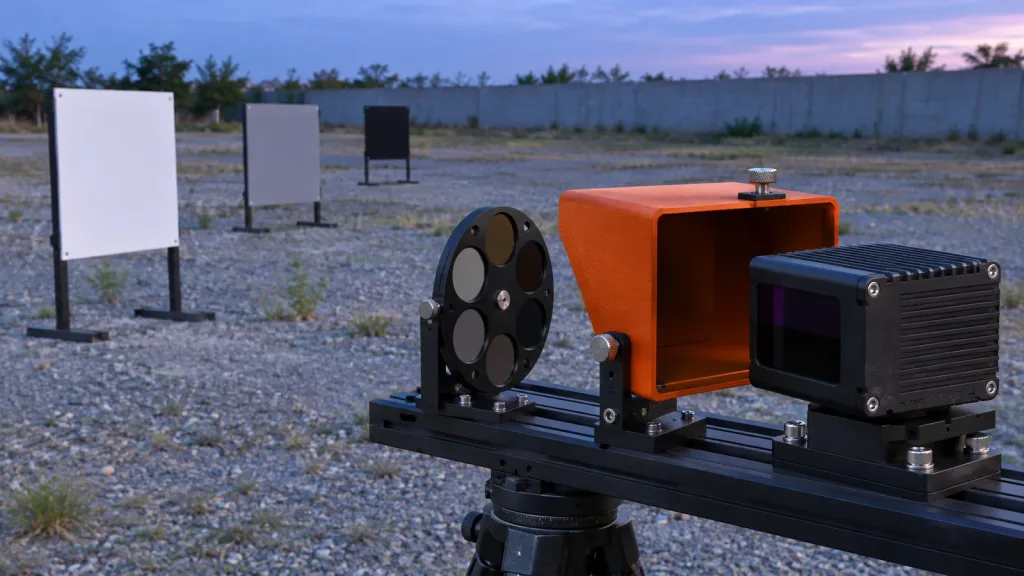
- Treating a stated range as an application result. Preserve the documented baseline, then test the target, angle, light, motion, and mounting that matter to your application.
- Calling a sensor a complete avoidance system. A depth module provides sensing data; system perception, planning, actuation, and validation are separate work.
- Turning “Class 1” into a blanket end-product conclusion. Keep the supporting statement, but review the actual finished equipment, market, and applicable requirements with the responsible specialists.
RFQ and pilot-order checklist
Use these questions in an RFQ or evaluation request. They make the response easier to compare and give the engineering team a usable handoff.
- What platform and application are we evaluating: UAV, robot, AR/VR, inspection, or another use?
- What target types, distances, lighting conditions, mounting constraints, and motion define the first pilot?
- Which model and documented configuration are requested, and how will the quote/sample identity be retained?
- Which interface—UART, UVC, or UDP—will the host evaluate first?
- Do we need depth frames, point clouds, or both, and what raw evidence will be saved?
- What mount, power source, host OS, cable route, and data-capture tool will be used?
- Which laser-class documentation should be kept with the project, and who owns final-equipment review?
- What constitutes a bench pass, an evidence gap, and a reason to expand or stop the pilot?
- Who will receive technical questions or configuration-change notices?
Before finalising your list, pair it with the site's solid-state LiDAR selection scorecard, the broader pilot-build validation guide, and the related dToF LiDAR evaluation FAQ.
Request the right evidence with your next sample
If you are evaluating a compact dToF module for a UAV, robot, AR/VR, or inspection project, start with your application, working-distance band, environment, host system, preferred interface, sample quantity, and project timing. Then request the product documents, SDK resources, sample data, an evaluation sample, or a project-specific quote for the MRP-LD1 Drone LiDAR Sensor.