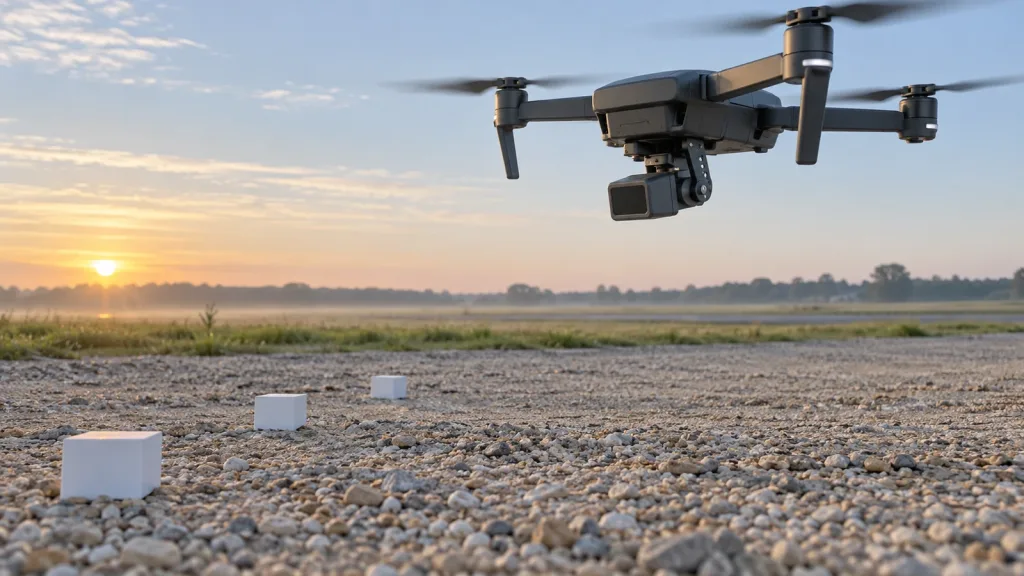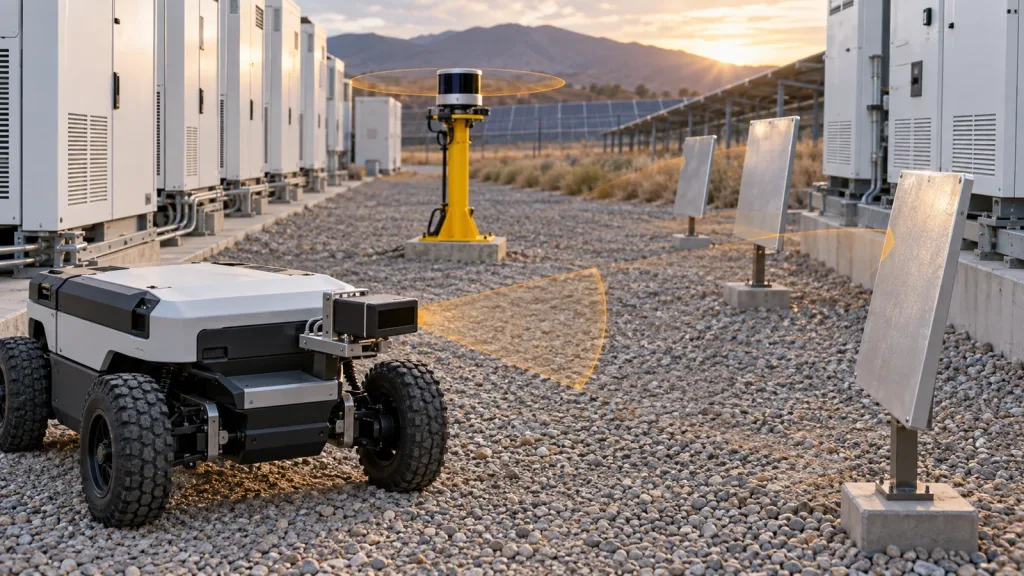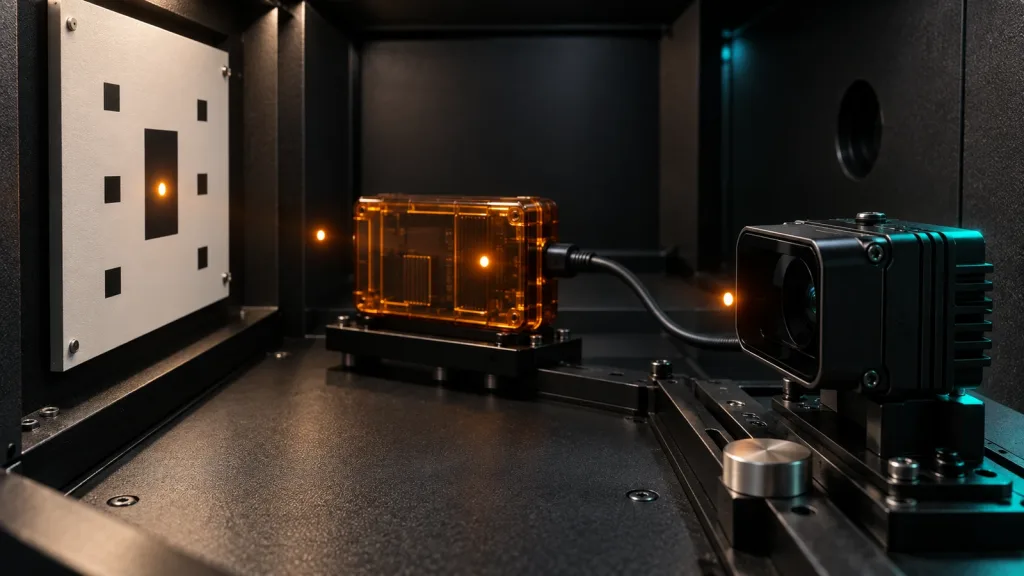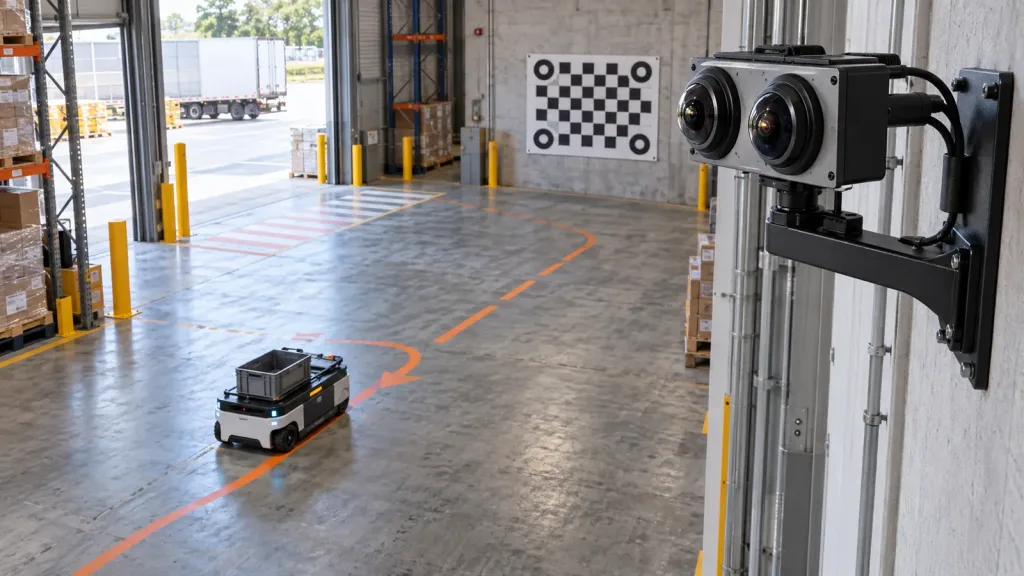
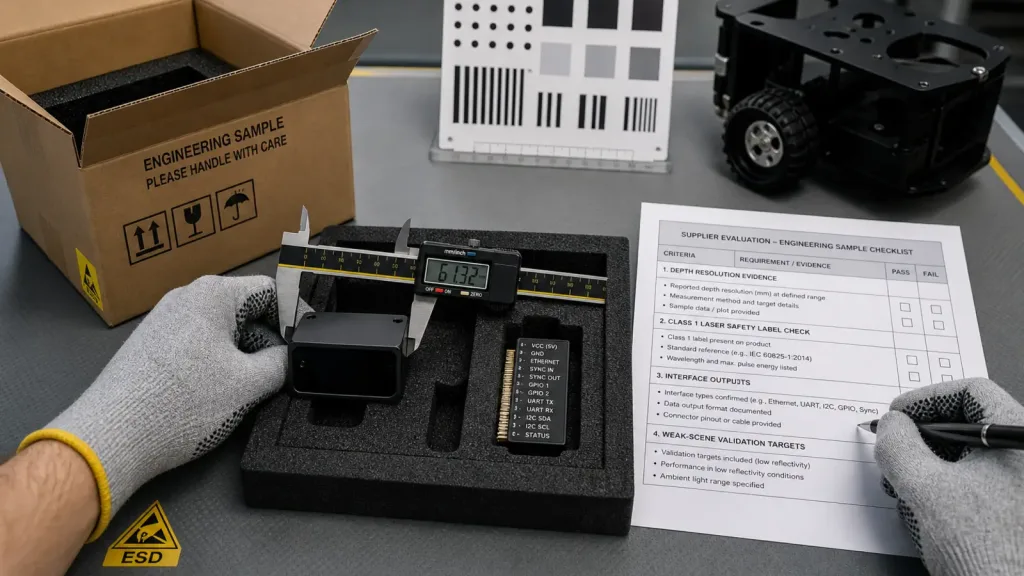
solid state lidar manufacturer pages often make the shortlist look simple: compare range, size, power, and price language, then request a sample. That is the wrong sequence for a technical buyer. Before you approve an engineering sample, you need proof that the supplier can show target-dependent depth behavior, explain what its safety label does and does not prove, get data into a real host path, and produce evidence from weak or degenerate scenes instead of polished demo shots only.
This guide is written for sourcing engineers, robotics integration leads, and UAV perception teams who need a practical way to screen a solid-state LiDAR supplier before sample approval.
| Quick answer | A credible solid-state LiDAR manufacturer should be able to show target-specific depth evidence, clear laser-safety labeling, documented interface outputs, and replayable weak-scene validation before you approve a sample. |
|---|---|
| Best fit | Robotics, UAV perception, and embedded-vision teams screening compact solid-state dToF modules for evaluation, pilot, or RFQ work. |
| Decision rule | If the supplier can quote range and weight but cannot show how the sample behaves on your real targets and host path, it is not ready for shortlist approval. |
What a solid state lidar manufacturer should prove first
The phrase solid state lidar manufacturer sounds like a supplier lookup query, but the real buying problem is evidence quality. A serious supplier should be able to show more than a clean range headline and a polished hero image. It should show what depth changes the sensor can actually separate on relevant targets, how the output reaches a host stack, and how the module behaves in scenes that are harder than a centered demo board.
NIST's April 27, 2026 publication Bootstrap Metric for Quantifying the Depth Resolution of 3D Sensors is useful because it defines depth resolution as the smallest physical depth change that causes a detectable change in measured depth, and it ties that to sensor noise on the target. In buyer language, that means you should not accept one generic range number as proof that a sample is useful. You should ask whether the module can separate the physical depth differences that matter in your own application.
The FDA's current laser-products guidance is the second sanity check. A supplier may correctly state a laser class, but a class label is not the same thing as full application approval for your final deployed system. It is still valuable because it shows the supplier understands laser-product labeling and hazard classification, but buyers should read it as one proof point, not as the entire safety case.
The third proof area is host handoff. Official Nav2 documentation shows obstacle and voxel workflows using LaserScan and PointCloud2 inputs. If a supplier claims UART, UVC, UDP, or broader host support, ask how that path becomes a replayable dataset or a real robotics message flow. A good sample program should make the first logging and replay path obvious.
Finally, current primary research still warns against over-trusting perfect demos. The 2026 paper Environment-Adaptive Solid-State LiDAR-Inertial Odometry shows that solid-state LiDAR can still struggle in geometrically degenerate or perceptually degraded environments. That is exactly why buyers should ask for corridor, low-structure, or mixed-surface evidence before calling a supplier shortlist-ready.
Decision chart for supplier screening
| Screening area | What to verify | Why it matters | Reject if |
|---|---|---|---|
| Depth evidence | Whether the supplier can show usable depth separation on the targets and materials that match your application | Useful performance is target-dependent, not headline-dependent | The proof is only a single flat target or a single max-range claim |
| Laser-safety clarity | Whether the supplier states the class clearly and documents the scope of that claim | Buyers need to distinguish device labeling from full system approval | The class claim is vague, missing, or used as a substitute for all other safety evidence |
| Host-path readiness | How the sample reaches the first replayable dataset or robot host workflow | Integration risk often appears before algorithm risk | The supplier names interfaces but cannot explain the first usable data path |
| Weak-scene proof | How the sample behaves in corridors, partial structure, mixed reflectivity, or low-feature geometry | Compact solid-state LiDAR can still degrade in difficult scenes | All evidence is taken from ideal geometry only |
| Documentation support | Whether the supplier provides enough interface, format, and validation documentation to move beyond a visual demo | Sample approval should lead to repeatable engineering work, not guesswork | The buyer cannot identify a next step after the sample arrives |
Featured-product facts you can use to question a supplier
The current Featured product for this workflow is the LiDAR Drone Module – MRP-LD1 Solid-State dToF Sensor. The facts below come directly from the Featured WooCommerce export and are the factual product baseline for this article.
| Parameter | Published value | Supplier-screening question |
|---|---|---|
| Ranging principle | dTOF | Can the supplier show target-specific depth behavior rather than only rendered visual output? |
| Scanning principle | SPAD (Single-Photon Avalanche Diode) | What evidence supports sensitivity claims on the buyer's actual materials? |
| Emitter | 940nm VCSEL | What environmental or material limits should the buyer test during evaluation? |
| Laser safety | Class 1 (FDA Recognized Eye-Safe) | What does the supplier claim at module level, and what still belongs to the final system review? |
| Range | Indoor 0.5-25m; outdoor 0.2-8m | What scene-specific evidence shows the useful range band for the buyer's target task? |
| Ambient-light resistance | 80Klux | Can the supplier show test evidence under lighting closer to the buyer's environment? |
| Accuracy | 0.2-1m <= +/-3cm; 1-5m <= +/-5cm; 5-8m <= +/-10cm; 8-15m <= +/-20cm | How do those bands map to the application's stop, clearance, or measurement thresholds? |
| FoV | 60 degrees (H) x 45 degrees (V) | What mounting geometry or scene fit evidence shows that the FoV is adequate? |
| Resolution / frame rate | 40 x 30 at 10fps | What target types and use cases remain credible at that output density? |
| Interfaces | UART / UVC / UDP | Which interface gets the buyer to the first stable replayable dataset fastest? |
| Software support | Windows / ARM / Linux / Android | What documentation and examples prove the path beyond a generic compatibility claim? |
| Power / weight | 5V, 1.2W, 8g | How does the compact form factor translate into the buyer's actual mounting or integration envelope? |
Sample-approval workflow before you say yes
1. Define the real task before comparing suppliers
Ask what the sensor must do in the first proof run. Is it obstacle detection on a compact robot, altitude and obstacle support on a UAV, or a lab-side evaluation for a future embedded system? If the task is vague, every supplier presentation starts to look better than it really is.
2. Ask for target-dependent evidence, not just range language
NIST's framing is helpful because it pushes the buyer to ask a better question: what physical depth changes can the sample detect on the targets we care about? That usually leads to better sample discussions than asking for a broader marketing deck.
3. Turn the solid state lidar manufacturer query into an engineering checklist
Before you shortlist a supplier, ask for evidence in four buckets: target-dependent depth behavior, safety labeling scope, host-path documentation, and weak-scene validation. A supplier that answers all four with specific evidence is more credible than one that answers only with a clean product card.
4. Make the first replayable data path explicit
If the sample supports UART, UVC, and UDP, choose the route that gets your team to the first saved dataset with the least friction. If your team needs help evaluating that choice, use UART, UVC, or UDP, the documentation hub, and the sample datasets before you expand the pilot.
5. Ask for weak-scene proof before final shortlist approval
A buyer does not need a full production deployment to ask a hard question. Ask the supplier to show evidence from scenes with poor geometric richness, mixed reflectivity, or partial structure. If that evidence does not exist yet, the sample may still be worth testing, but it should not be treated as a de-risked supplier choice.
Interface, data, and integration section
Official Nav2 documentation is useful because it shows how a robotics stack may consume LaserScan and PointCloud2 inputs in obstacle and voxel workflows. That does not mean every buyer runs Nav2. It means interface claims should be tested against a concrete data path. A supplier who says "Windows, ARM, Linux, Android" should also be able to explain which path gets the buyer to a first replayable dataset and what documentation supports it.
| Integration question | What a serious supplier should clarify |
|---|---|
| First host | Which operating system or host board is the fastest route to a valid proof run? |
| First data form | Will the buyer begin with visual review, structured depth output, or a direct robotics message path? |
| Replay support | Can weak frames be saved, replayed, and compared under the same scene setup? |
| Output ownership | Who owns parsing, middleware conversion, and failure diagnosis once the sample arrives? |
| Cross-program fit | If the same module family may touch robotics and UAV work, what proof belongs to each workflow? |
For related reading, buyers can also review VCSEL LiDAR: What Buyers Should Verify Before They Shortlist a 940 nm Module, Single-Photon Avalanche Diode for dToF LiDAR Buyers, and common LiDAR integration issues and how to diagnose them when the sample review moves deeper into product and host questions.
Realistic application case
Consider a technical buyer who is screening suppliers for a compact module that may first go into a mobile robot proof build and later support UAV perception evaluation. The team does not need the perfect vendor speech. It needs a sample that can be tested quickly, documented cleanly, and defended internally.
- Use the supplier's published facts to define the first acceptance scene and the first host path.
- Ask for evidence on mixed targets rather than on one centered board.
- Confirm what the safety label means at module level and note what still belongs to system review.
- Save the first weak-scene dataset instead of relying on a one-time live impression.
- Approve the sample only when engineering, purchasing, and integration owners can all explain why it is worth the next step.
This case matters because supplier risk is usually created by ambiguity, not by lack of enthusiasm. The better the evidence package, the lower the cost of the next decision.
Common mistakes
- Comparing suppliers from range and size headlines before defining the real target scene.
- Treating a Class 1 statement as if it were the entire safety case for the final deployed product.
- Accepting interface names without asking how the first replayable dataset will be captured.
- Letting a polished demo replace evidence from mixed reflectivity, weak geometry, or partial structure.
- Approving a sample without deciding who owns parsing, middleware, and weak-scene diagnosis.
- Using generic vendor-ranking content instead of writing down the actual proof required for the buyer's task.
RFQ and evaluation checklist
| Checklist item | Why it belongs in the RFQ |
|---|---|
| Target-dependent depth evidence | Forces the supplier to prove performance on useful scenes instead of generic range language. |
| Laser class documentation | Clarifies what the module label states and prevents safety over-interpretation. |
| Interface and format description | Moves the discussion from vague compatibility to real host planning. |
| Weak-scene validation set | Reveals whether the supplier has tested beyond ideal geometry. |
| Replayable sample data | Lets engineering and purchasing review the same evidence. |
| Documentation and dataset references | Shows whether the supplier can support a serious evaluation workflow. |
| Escalation owner | Prevents the sample from stalling between optics, firmware, and host-integration questions. |
Shortlist the evidence, not the slogan
The right supplier conversation starts with the first proof you need, not the widest claim on the product card. A credible solid-state LiDAR manufacturer should be able to show target-dependent depth behavior, explain its safety labeling, document the host path, and provide weak-scene evidence before the sample becomes an internal commitment.
- Start with the target scene, the host path, and the exact proof your team needs to approve the sample.
- Use product facts, documentation, and replayable data to compare suppliers on engineering evidence instead of generic marketing language.
Purpleriver, founded in 2015, develops solid-state dToF LiDAR technology and publishes product, interface, and documentation resources that can support this style of evaluation around the MRP-LD1 module.
Contact Purpleriver with your target scene, host path, and sample-approval checklist so the discussion starts from evidence instead of assumptions.