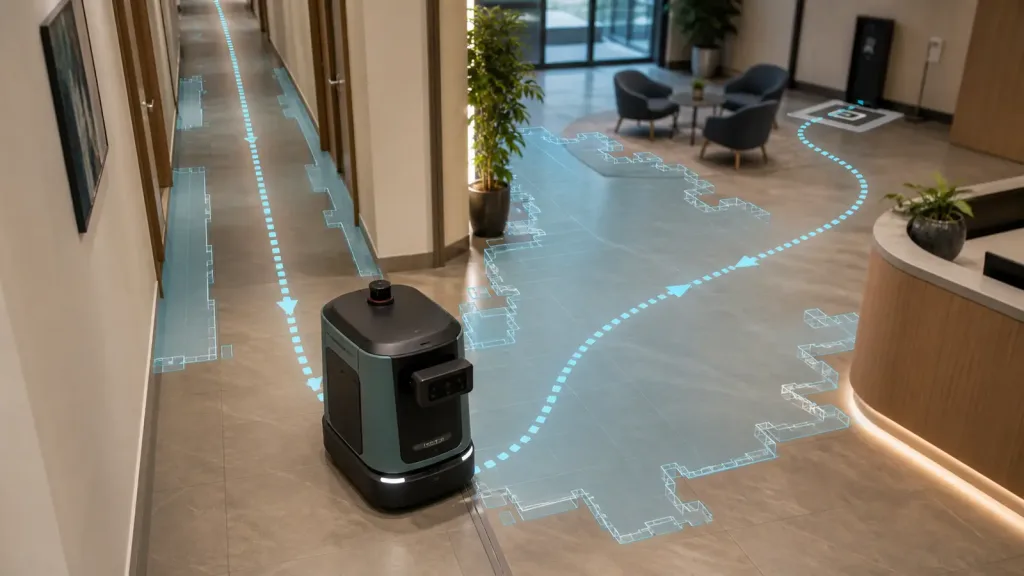
slam navigation dToF lidar for service robot is not proven by one attractive hallway map. It is proven when the robot can leave a narrow corridor, enter a wider lobby, approach a docking reference, and come back with pose ownership, sensor evidence, and route logic that still make sense when you replay the run. A compact dToF module is valuable only when the team understands where the geometry helps it, where the geometry weakens it, and what part of the stack owns the resulting behavior.
This guide is for service-robot integrators, robotics engineers, and technical buyers who need a disciplined indoor proof workflow before approving customer-floor trials in clinics, offices, hotels, reception areas, or other corridor-plus-lobby environments.
| Quick answer | Prove slam navigation dToF lidar for service robot by checking corridor reference quality, transform ownership, host-side map handoff, and a return-to-dock run that remains interpretable after the robot leaves repetitive geometry and re-enters it. |
|---|---|
| Best fit | Indoor service-robot programs using a compact solid-state dToF LiDAR for SLAM, localization, docking return, and obstacle-aware route screening. |
| Decision rule | If the team cannot explain the outbound pass, the open-space transition, and the dock return with synchronized sensor and transform evidence, the module is not ready for a public pilot. |
Why slam navigation dToF lidar for service robot must be judged as an indoor route system
The current Nav2 mapping and localization guide is a useful reminder that robot navigation is a chain, not a sensor checkbox. The official docs tie robot motion to SLAM, map generation, scan topics, and localization handoff. Nav2's concepts documentation also states that the map -> odom relationship comes from localization or SLAM and the odom -> base_link relationship comes from the odometry system. If those relationships are weak or unstable, a service robot can look like it has a LiDAR problem when the real problem is state-estimation ownership.
The 2026 paper on environment-adaptive solid-state LiDAR-inertial odometry adds another practical warning: solid-state LiDAR can still degrade in geometrically degenerate environments and weak observations can damage localization quality. For service robots, that matters most in long corridors, doorway transitions, and open lobbies where the geometry changes from constrained to sparse. That is why the acceptance target should be an indoor route system, not a single map snapshot.
If you need broader context first, use LiDAR for Robotics, robotics mapping LiDAR for AMR and service robot navigation, and point-cloud evaluation before integration. This article is narrower: it is about what a team should prove before a compact dToF LiDAR earns trust on a real service-robot floor.
Indoor proof bias is why hallway demos mislead teams
Straight hallways often make compact SLAM look easier than it really is. The robot sees simple wall references, the operator gets a clean trace, and everyone leaves the room assuming the system is ready. The trouble usually appears only when the robot crosses a threshold into a wider open area, turns near a reception desk, or tries to close the loop back to a dock. If the first proof run does not force those moments, the team is testing a demo path, not a deployment path.
Readiness matrix for corridor, lobby, and dock proof
| Evaluation area | What to verify | Why it matters | Reject if |
|---|---|---|---|
| Reference quality in corridors | Whether wall runs, recesses, and door-frame edges remain useful across the full hall length | Repetitive geometry can make early SLAM confidence look stronger than it is | The route proof uses only one short, easy corridor section |
| Transition into open space | How the robot behaves when it leaves the constrained hall and enters a wider lobby or waiting area | Geometry often becomes less informative exactly where the route needs confidence | The lobby segment is skipped or reviewed only visually |
| Pose ownership | Whether the team can identify which layer owns the active pose relationships during replay | Unclear frame ownership turns every drift event into guesswork | The team cannot say who owns map -> odom and odom -> base_link during the failure |
| Loop return quality | How cleanly the robot returns to a known dock or prior corridor node | Service robots are judged by repeatable returns, not just outbound movement | The return path snaps, drifts, or becomes ambiguous |
| Replay package | Whether weak runs can be reviewed with synchronized route, transform, and sensor evidence | One successful run is not enough to approve customer-floor work | The team can describe the issue but cannot reconstruct it |
Exact featured-product parameters to screen
The current Featured product is the LiDAR Drone Module - MRP-LD1 Solid-State dToF Sensor. The Featured export lists robot navigation, obstacle avoidance, and SLAM in its approved application scope. That makes it a valid factual basis for a service-robot article, provided the team still proves route behavior rather than assuming the module alone decides success.
| Parameter | Published value | Service-robot implication |
|---|---|---|
| Ranging principle | dTOF | Evaluate the route in motion, not just a stationary mapping scene. |
| Scanning principle | SPAD | Use weak or repetitive geometry in the route so sensitivity claims are tested against real deployment structure. |
| Emitter | 940nm VCSEL | Include mixed-light entrances and reflective trim instead of testing only one lighting zone. |
| Laser safety | Class 1 (FDA recognized eye-safe) | Useful for screening, while the actual service floor still needs its own safety review. |
| Range | Indoor 0.5-25m; outdoor 0.2-8m | Judge route relevance against real indoor references, not the longest possible line of sight. |
| Ambient-light resistance | 80Klux | Glass entrances and brighter reception spill still belong in the route proof. |
| Accuracy | 0.2-1m <= +/-3cm; 1-5m <= +/-5cm; 5-8m <= +/-10cm; 8-15m <= +/-20cm | Translate the bands into docking repeatability, hallway margin, and return consistency targets. |
| Field of view | 60 degrees (H) x 45 degrees (V) | Compare the visible corridor against door recesses, desk corners, and dock references before acceptance. |
| Resolution / frame rate | 40 x 30 at 10fps | Acceptable for compact indoor pilots if the team defines the route evidence it needs. |
| Interfaces | UART / UVC / UDP | Choose the path that preserves replayable proof first, then optimize. |
| Software support | Windows / ARM / Linux / Android | Helpful when robot control, logging, and review happen on different hosts. |
| Power / weight | 5V, 1.2W, 8g | Useful for compact indoor platforms, but still secondary to route proof. |
Validation workflow before customer-floor trials
1. Build a route that includes both constraint and release
Define one route segment that starts in a constrained corridor and then opens into a wider lobby or waiting area. Add a return segment to a dock or known corridor node. Without that combination, the team is not testing the geometry change that often exposes weak indoor SLAM.
2. Assign pose ownership before anyone tunes parameters
Before the first route review, decide who owns the transform chain, who owns odometry assumptions, and who owns the route replay artifacts. If a route drifts at the lobby turn or during the dock return, that ownership map will save days of blind debugging.
3. Keep the first evidence path simple but complete
Use the simplest scan or point-cloud path that still lets the team diagnose weak geometry later. A simple path is good. A path that deletes the only useful evidence is not. This is where UART, UVC, or UDP and the documentation resources are helpful: they keep the discussion attached to real data flow instead of vague integration talk.
4. Force the robot to come back through the same references
Do not stop the proof after the outbound path looks good. Make the robot return through the same corridor and compare what happened at one doorway, one desk edge, and one dock reference. Service-robot readiness depends on repeatable return behavior more than on one attractive forward pass.
5. Review geometry weakness, not just obstacle avoidance
Obstacle avoidance can look acceptable while SLAM quality is already degrading. Review repetitive wall runs, threshold symmetry, and open-space sparsity as separate route questions. Those are often the first clues that the system is losing structural confidence before it fully fails.
6. Stop expansion when the route cannot be explained
If the team cannot replay the run cleanly, cannot assign pose ownership, or cannot explain the dock return, stop the expansion. A customer-floor trial is not the place to discover that your evidence path is ambiguous.
Interface, data, and map-ownership planning
Service-robot mapping programs lose time when controls, middleware, and sensing teams work from different artifacts. Lock the handoff rules before you scale the route.
| Integration topic | Questions to answer before wider trials |
|---|---|
| Sensor input path | Which topic did the stack actually consume during the run, and can the team replay that exact path? |
| Transform responsibility | Who verifies live frame relationships after software or mounting changes? |
| Evidence richness | Will the first pass preserve only scan data, only point clouds, or both? |
| Return comparison | How will outbound and return passes be compared at the same reference points? |
| Route geometry set | Which corridor, threshold, desk, and dock references must remain readable? |
| Escalation path | When the route weakens, does the next action belong to transforms, host handoff, sensor placement, or route design? |
The most useful internal follow-on references here are common LiDAR integration issues, point-cloud evaluation, and robotics mapping LiDAR for AMR and service robot navigation.
Realistic application case: clinic corridor, reception desk, and dock return
Imagine a service robot leaving a charging dock in a clinic corridor, passing door recesses, turning into a reception area, stopping near a desk-side marker, then returning to the dock. The objective is not full-building autonomy. The objective is to prove that the compact dToF LiDAR stack can handle repetitive walls, a wider open space, and a closing return loop without the evidence becoming ambiguous.
- Capture one route that stays mostly in the corridor and a second that enters the reception zone.
- Replay the two runs while verifying live pose ownership and route evidence continuity.
- Force the robot back to the dock through the same corridor instead of ending after the desk-side stop.
- Compare one door frame, one open-space turn, and one dock reference across the outbound and return passes.
- Advance the program only if the team can explain the full loop without relying on guesswork.
This matters because indoor service deployment is won by consistent repeatability, not by one smooth outbound corridor run.
Common mistakes when validating slam navigation dToF lidar for service robot
- Signing off after one pretty hallway map.
- Ignoring the return-to-dock pass.
- Tuning SLAM before assigning transform ownership.
- Throwing away the only evidence needed to diagnose weak geometry.
- Skipping the lobby or waiting-area transition because the corridor already looked good.
- Calling the system ready even though the replay package cannot reconstruct the weak run.
RFQ and engineering checklist
| Checklist item | Why it belongs in the approval sheet |
|---|---|
| Indoor route definition | Keeps the proof attached to the real geometry the robot must survive. |
| Corridor and lobby reference list | Forces repetitive and open-space sections into the first meaningful run. |
| Pose-owner assignment | Prevents drift from being diagnosed by speculation. |
| SLAM input record | Confirms exactly what the host stack consumed. |
| Return-to-dock comparison | Makes the team prove repeatability rather than one-way movement. |
| Replay package | Ensures weak runs can be reviewed after the route day. |
| Reject criteria | Stops expansion while map ownership or return consistency is still unclear. |
| Vendor support packet | Lets the next review start with route evidence instead of a generic request for better SLAM. |
Approve the dock return before you approve the stack
A compact solid-state LiDAR earns trust on a service robot only when your team can explain repetitive-corridor coverage, map ownership, lobby transition behavior, and dock return stability with evidence it can replay later.
- Bring your corridor plan, transform assumptions, and return-loop evidence to the review instead of asking for a generic indoor SLAM demo.
- Use the MRP-LD1 product page, documentation resources, and point-cloud review workflow to tighten the next trial cycle.
Purpleriver, founded in 2015, develops solid-state dToF LiDAR technology for robotics perception, service-robot navigation, UAV, and industrial depth-sensing workflows.
Contact Purpleriver with your corridor geometry, docking layout, host-stack assumptions, and replay package if you want to align module fit before a wider customer-floor rollout.