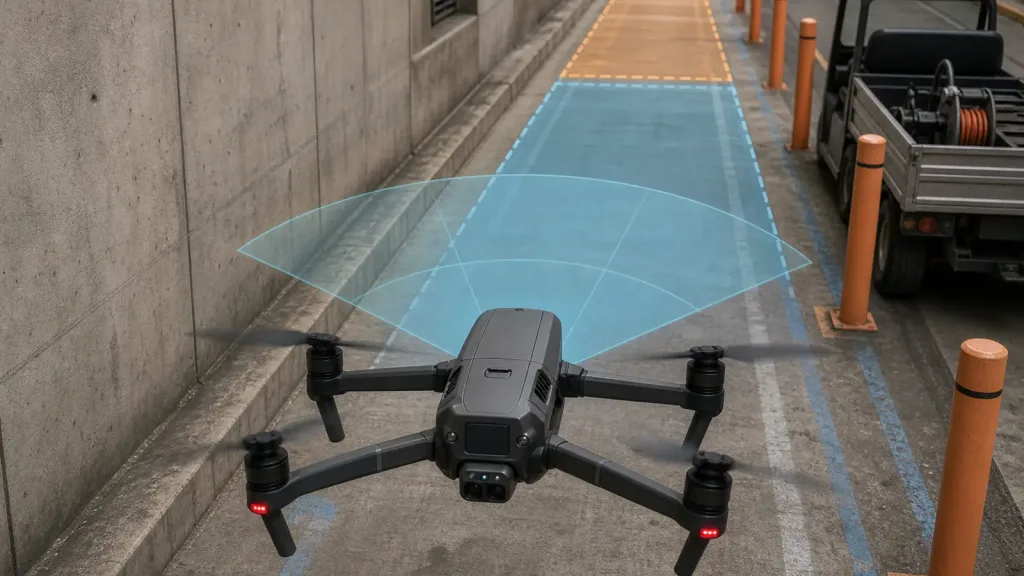
Backward Obstacle Sensing sounds complete until a UAV team has to prove what actually happens when the aircraft drifts, retreats, or reverses near a wall, pole, parked vehicle, or scaffold edge. The weak step is rarely sensing in the abstract. It is the jump from "our drone has rear awareness" to "our rear sector is wide enough, our brake logic triggers in time, and our logs prove safe retreat behavior in the modes we plan to use."
That gap matters for integrators, buyers, and flight-test leads. A rear obstacle claim can mean warning only, automatic braking, active bypass, or a simple pilot-assist view. Unless the team separates those behaviors and validates them against real rear-sector geometry, the phrase becomes a marketing shortcut instead of a technical capability.
| Quick answer | Approve Backward Obstacle Sensing only after you verify rear-sector coverage, mode-specific brake or bypass behavior, retreat-speed margin, and replayable data showing that the aircraft stayed safe when moving backward near real obstacles. |
|---|---|
| Best fit | UAV integration teams, autonomy engineers, and technical buyers evaluating whether a compact LiDAR-assisted stack can support safe reverse repositioning, facade retreat, or return-path protection. |
| Main risk | Assuming rear sensing is already solved because the aircraft has forward obstacle hardware, while the real rear coverage, trigger logic, or flight-mode behavior has never been proved. |
Why Backward Obstacle Sensing claims fail
The first mistake is treating all rear protection as the same thing. Current PX4 collision-prevention documentation makes the underlying rule clear: obstacle-prevention behavior depends on the vehicle type, flight mode, motion limits, and whether sensors cover the relevant directions. That means a UAV can have a rear sensor or a rear-facing depth stream without automatically having a proven rear brake behavior in every mode the sales sheet implies.
The second mistake is confusing warning, back-away, and bypass behavior. Current ArduPilot simple object-avoidance documentation distinguishes active backing away from an obstacle from weaker forms of proximity awareness. That distinction matters because buyers often hear "rear sensing" and assume the vehicle will always stop or move clear. In practice, the firmware, companion logic, and direction coverage decide whether the aircraft merely reports a threat or actually protects a retreat path.
A third mistake comes from consumer terminology. DJI's current obstacle-avoidance overview and APAS documentation describe obstacle sensing as a system with different behaviors by product, direction, and mode. That is exactly why engineering teams must validate rear behavior on their own platform instead of borrowing assumptions from a different aircraft or app setting.
Purpleriver already covers broader drone obstacle-avoidance requirements, forward obstacle sensing, downward vision, and core drone LiDAR terms. This article narrows the question to rear-sector proof: what must exist before a team can claim safe backward motion near real obstacles?
| Question | What a rear sensor proves | What a real backward-sensing claim still requires |
|---|---|---|
| Can the aircraft see objects behind it? | A rear-facing LiDAR or depth sensor can supply distance or depth data in some rear field. | That the covered sector is wide enough to catch the actual retreat path, not just a narrow centerline. |
| Will the UAV stop before impact? | Not necessarily. A sensor feed alone does not prove brake logic or timing. | Mode-specific brake thresholds, trigger conditions, and retreat-speed margins that are flight-tested. |
| Will it steer around obstacles behind it? | Only if the flight stack supports that behavior in the relevant mode and direction. | A documented bypass or path-planning behavior plus evidence that side-clearance assumptions are valid. |
| Does a warning overlay count as protection? | No. It only proves the operator can be alerted. | That the operator or controller has enough time and authority to respond safely in a constrained retreat. |
| Is the system ready for a customer claim? | No, not from rear detection alone. | Only after coverage, brake behavior, mode limits, and replay logs all support the stated capability. |
What the MRP-LD1 facts mean for rear sensing
The Featured MRP-LD1 gives a compact dToF baseline for rear-sector experiments: SPAD sensing, 940 nm VCSEL illumination, 60 degrees by 45 degrees field of view, 40 x 30 output at 10 fps, 5 V supply, 1.2 W power, 8 g weight, and UART, UVC, and UDP interfaces. Those facts make it reasonable to build a rear-facing evaluation rig, but they do not by themselves prove rear brake behavior or reverse-path protection.
| Verified product fact | What it can support | What it does not prove by itself |
|---|---|---|
| Solid-state dToF with SPAD and 940 nm VCSEL | A lightweight active sensing path for a compact rear-facing evaluation setup. | That the UAV's flight stack will convert rear detections into braking or bypass behavior. |
| 40 x 30 output at 10 fps | Structured depth data that is more informative than a single scalar range reading during reverse tests. | That the reaction chain is fast enough for the aircraft's actual backward speed and stop distance. |
| 60 degrees x 45 degrees field of view | A usable rear sector for prototype retreat tests when the mounting geometry is disciplined. | That the FoV covers tail corners, angled retreat lines, or diagonal drift near a facade. |
| Indoor 0.5-25 m and outdoor 0.2-8 m range | Useful rear-distance data for close inspection lanes and low-speed reverse maneuvers. | That the aircraft can stop safely at the chosen retreat speed under the intended outdoor lighting mix. |
| UART, UVC, and UDP interfaces | Multiple evidence-capture paths for a flight controller, companion computer, or recorder. Purpleriver's interface guide helps frame those tradeoffs. | That the selected host path preserves the timing and logging detail needed to prove a rear brake event. |
| 8 g weight and 1.2 W power | A low payload penalty for tail or side-rear evaluation on a multirotor test bed. | That the sensor can be mounted free of prop wash, tail masking, vibration, or landing-gear blockage. |
A realistic retreat-path case
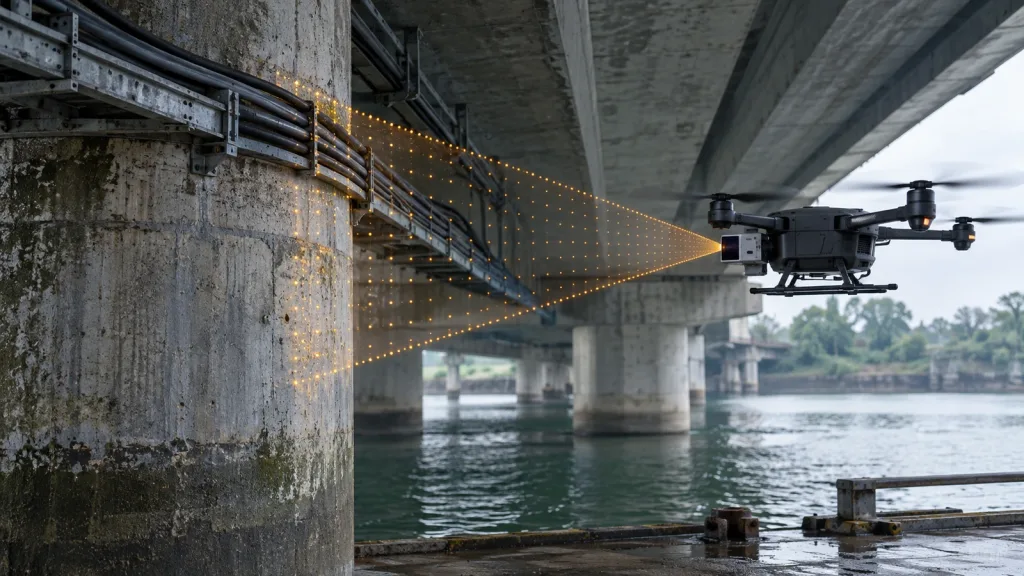
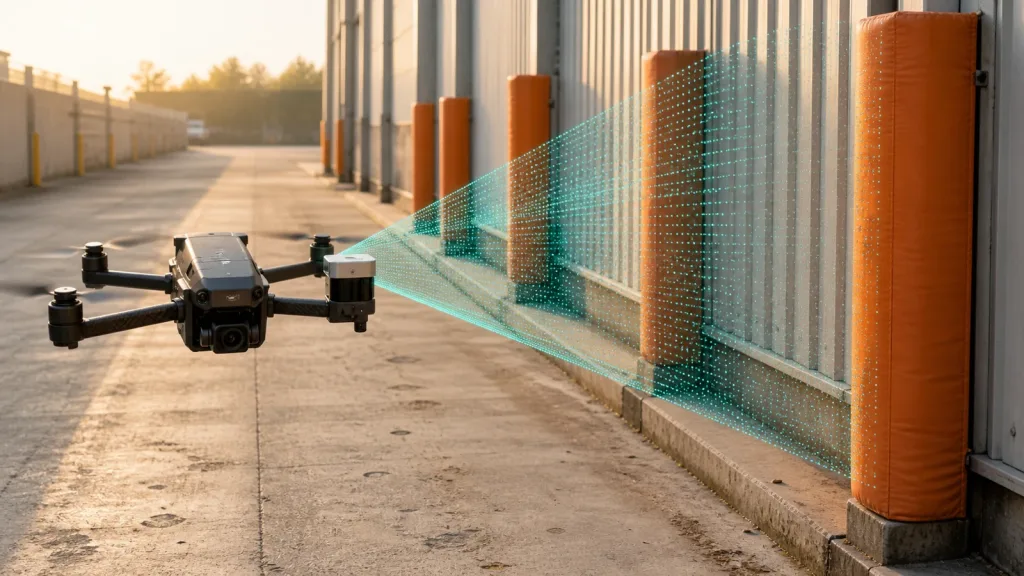
Imagine a compact multirotor inspecting a building facade from close range. The operator needs to back out of a narrow service lane bordered by a concrete wall on one side and bollards or parked equipment on the other. Forward sensing is not the dominant risk. The critical question is whether the aircraft can maintain a safe rear margin while retreating without drifting its tail into an obstacle that sits outside a narrow centerline beam.
This is where weak rear-sensing demos collapse. A bench test may show one obstacle directly behind the vehicle. A static alarm demo may show that a warning appears on screen. But the harder proof is whether the rear sector still covers the aircraft's true swept path while the vehicle yaws slightly, slides sideways, or backs out under imperfect pilot inputs.
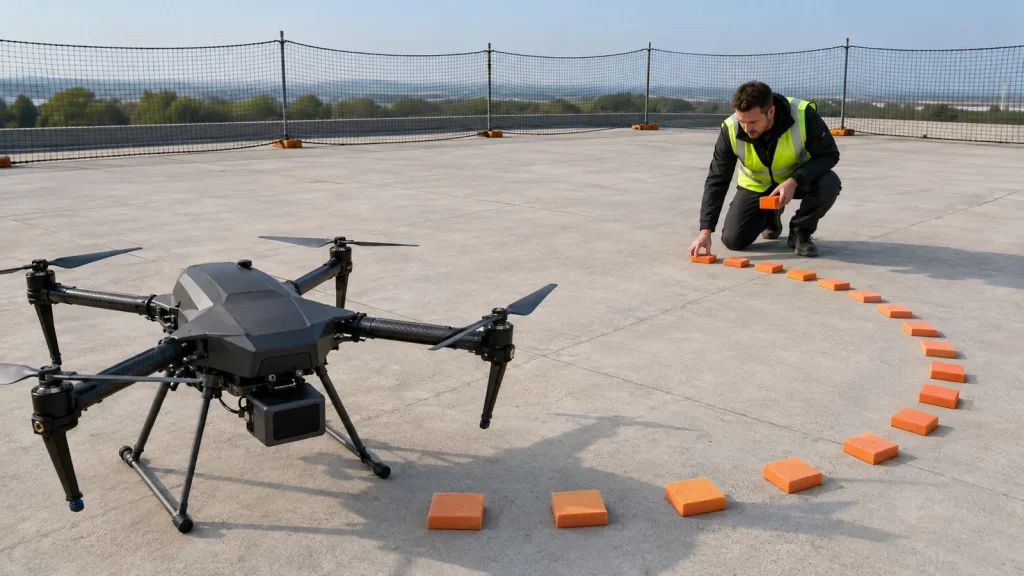
For that reason, the first rear validation route should not be a simple straight reverse. It should include a narrow retreat corridor, one diagonal obstacle offset from the centerline, and one low-speed brake check that proves the system still protects the intended retreat envelope rather than a single distance line.
Integration, modes, and evidence capture
How Backward Obstacle Sensing should be validated
Start by defining which layer owns the response. If the aircraft only exposes rear distance data, then the host controller, companion computer, or pilot still owns the actual safety action. That action might be a brake, a commanded stop, a back-away behavior, or simply a warning. The team should write that ownership into the test plan before hardware evaluation starts.
Then verify mode limits. Official platform documentation already shows why this matters. PX4 documents collision prevention for multicopters and specific modes, while DJI explains that obstacle-avoidance behavior and APAS availability vary by mode and direction. A rear claim that is true in a low-speed normal mode but false in a faster manual or sport-style mode must be stated that way in the evaluation report.
Rear coverage also needs geometry discipline. A sensor mounted under the tail can lose useful rear-corner coverage when the frame, payload, landing gear, or prop wash blocks part of the sector. Before requesting a sample approval, run a coverage map that includes straight reverse motion, slight yaw, diagonal retreat, and low-altitude hover drift. If your team needs a baseline troubleshooting path for the host stream, use Purpleriver's integration-diagnostics guide and the documentation hub as the local reference set.
For data capture, log more than a warning state. Record the raw or decoded rear distance stream, host timestamps, aircraft velocity, yaw rate, commanded retreat speed, obstacle position, and the exact condition that triggered a stop or bypass. Without replayable evidence, a team cannot tell whether a successful retreat happened because the rear sensing worked, because the pilot corrected manually, or because the aircraft never entered the real risk zone.
Common mistakes
- Assuming rear protection exists because the UAV already has strong forward obstacle behavior.
- Testing only one object directly behind the aircraft and ignoring diagonal or off-center retreat paths.
- Calling a warning overlay "obstacle avoidance" without proving brake, back-away, or bypass behavior.
- Ignoring mode limits, so the claim only holds in one slow mode while the aircraft is used differently in field operations.
- Capturing only a status flag instead of the actual rear distance stream, aircraft motion, and trigger timing.
RFQ and validation checklist
| Checkpoint | What to record | Pass condition |
|---|---|---|
| Rear-sector map | Measured rear coverage with the final mounting location, including diagonal retreat paths. | The covered sector matches the aircraft's true tail sweep and expected retreat corridor. |
| Behavior definition | Whether the system warns, brakes, backs away, or bypasses in each relevant mode. | The report states exactly what action is supported and under what conditions. |
| Retreat-speed margin | Aircraft backward speed, obstacle distance, and stopping or response distance. | The aircraft keeps a repeatable safety margin at the maximum intended retreat speed. |
| Off-center obstacle test | One diagonal or corner obstacle that challenges narrow centerline assumptions. | The system still protects the real retreat path, not only the exact rear axis. |
| Replayable logs | Rear distance stream, timestamps, aircraft motion, and trigger state. | The team can replay why a brake, warning, or bypass happened and whether it happened in time. |
| Procurement claim | Final wording for rear obstacle behavior in product, test, or pilot documentation. | The claim clearly separates rear sensing, rear warning, rear brake, and true autonomous avoidance. |
Use rear sensing as a proof workflow, not a checkbox
If your team is evaluating a compact rear-sector sensing stack, ask one direct question before the next pilot test: what exact protection action should happen when the aircraft retreats toward a real obstacle? If the answer is unclear, the system is not ready for a `Backward Obstacle Sensing` claim yet.
Use Purpleriver's MRP-LD1 product page as the verified product-fact source, then define the mounting geometry, retreat-speed margin, and replay-logging requirements that your rear-sector validation must satisfy.
Technical guide
FAQ
Common questions and practical answers from this technical guide.
Can a drone have rear sensing without true rear obstacle avoidance?
Yes. A UAV may detect or display rear obstacles without having any proven brake, bypass, or back-away behavior in the intended flight mode.
Why is rear-sector coverage harder than it sounds?
Because the true retreat path often includes yaw, drift, and diagonal motion. A narrow rear centerline view may miss the real tail sweep near a wall or corner obstacle.
Does a warning count as obstacle avoidance?
No. A warning only proves that the operator can be alerted. It does not prove that the aircraft or host logic will stop or steer clear in time.
What is the first useful rear-sensing flight test?
A narrow retreat corridor with one off-center obstacle and one controlled brake check is more useful than a simple straight-back motion in open space.
Why do flight modes matter so much?
Because many official platforms limit avoidance behaviors by vehicle type, control mode, or speed. A claim that is true in one mode may fail in another.
How can a compact dToF module help in rear validation?
It can provide structured active depth data for close-range retreat tests, especially when the team needs more than a single scalar range measurement.
What should be logged during a rear brake test?
At minimum, capture the rear distance stream, timestamps, aircraft speed, yaw, trigger state, and the obstacle geometry relative to the retreat path.
What is the best procurement outcome from a rear-sensing pilot?
A precise statement of supported rear behavior, with mode limits and evidence, instead of a vague promise that the aircraft has rear obstacle sensing in all conditions.