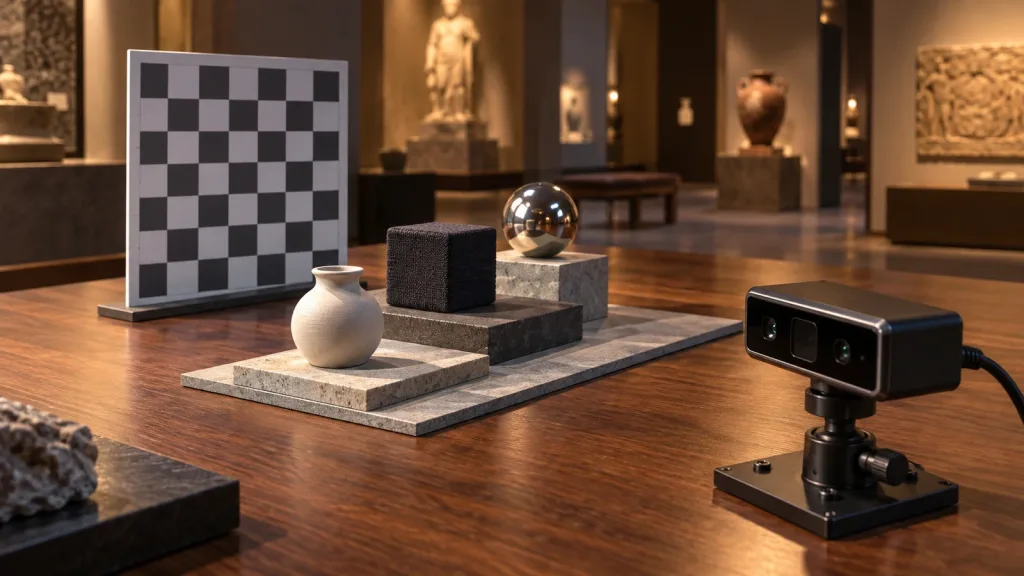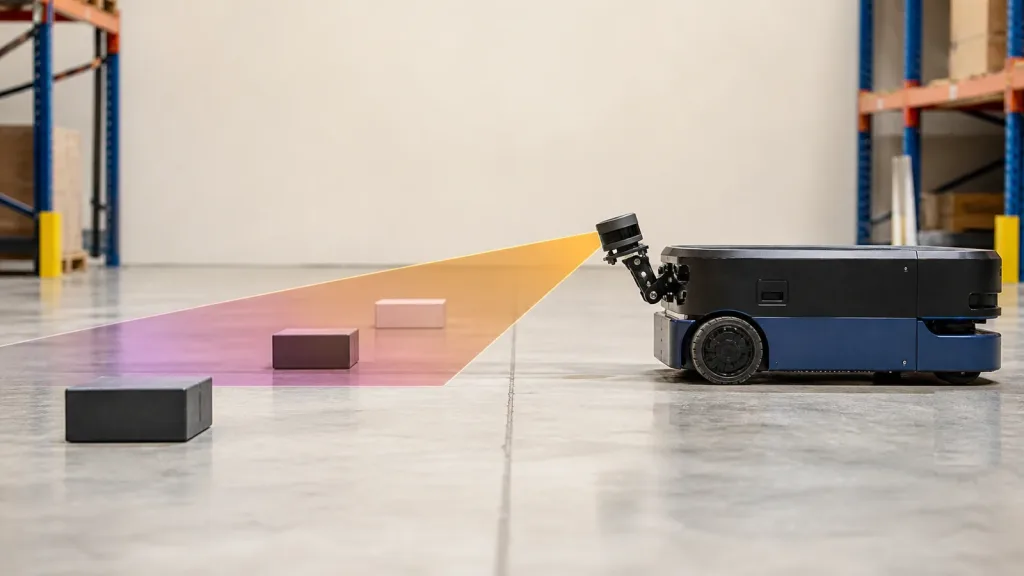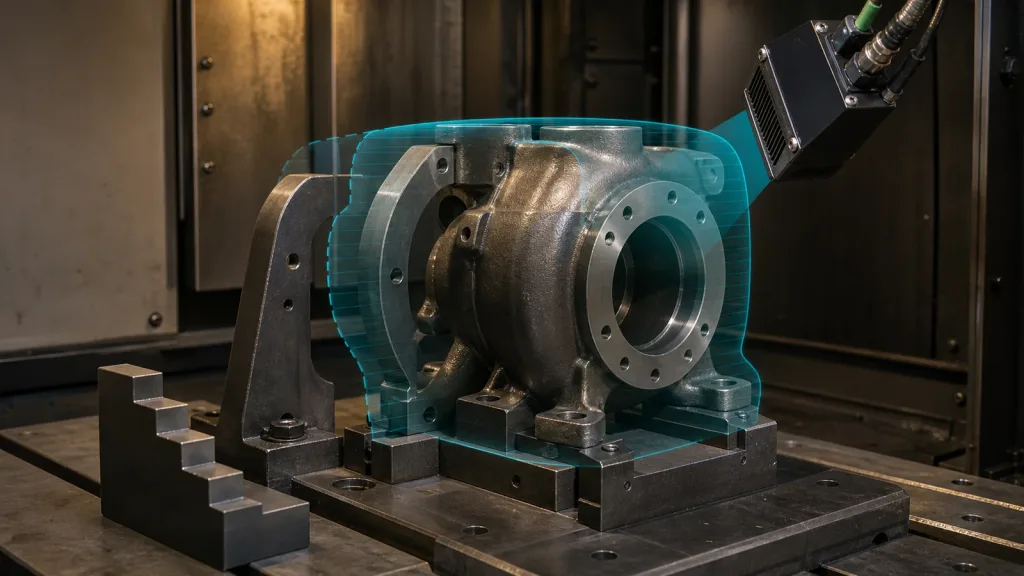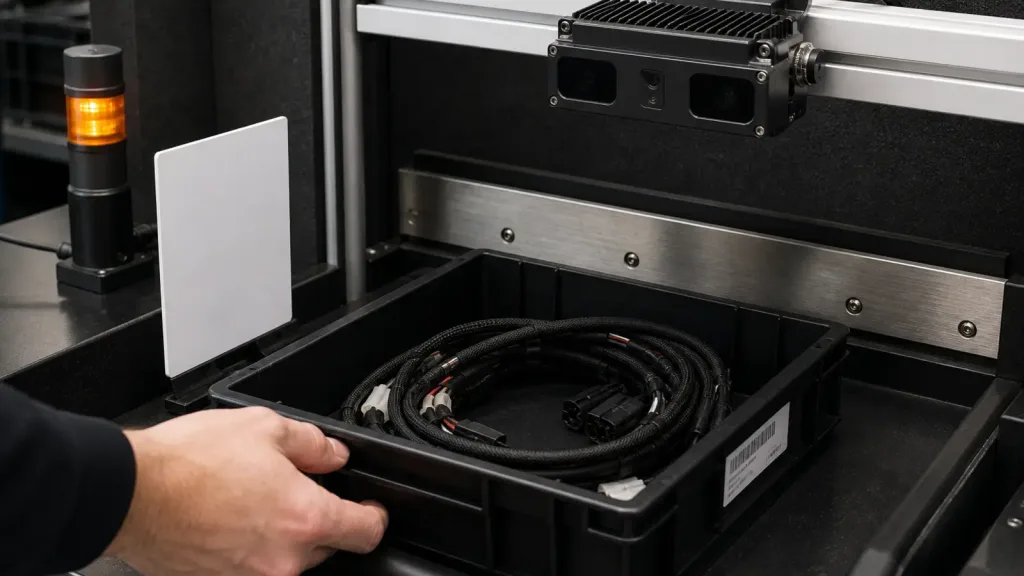
SPAD LiDAR usually looks convincing in a clean demo long before it earns a place on a real shortlist. The weak point is not the phrase "single-photon" itself. It is the gap between a promising photon-sensitive architecture and the evidence a robotics or inspection team needs to prove useful depth coverage, stable confidence, and a workable data path in dim or reflective scenes.
This guide is written for robotics integration leads, industrial-inspection engineers, and technical buyers who need a practical way to decide whether a compact SPAD-based module deserves sample approval and bench time.
| Quick answer | Shortlist SPAD LiDAR only after you verify usable scene coverage, reflective-surface behavior, replayable depth evidence, and the fastest interface path for your first real validation run. |
|---|---|
| Best fit | Compact robotics and industrial-inspection programs that need short-range depth awareness in mixed light, dim service areas, or reflective industrial scenes. |
| Decision rule | If the team cannot define its test scene, confidence review path, and pass or fail evidence for reflective or low-light conditions, the module is not ready for sample approval. |
Why SPAD LiDAR changes early shortlist questions
STMicroelectronics describes Time-of-Flight sensors as compact, low-power solutions used in robotics and industrial applications, and its current VL53L5CX product page explicitly notes an integrated SPAD array and ambient-light-aware ranging architecture. That is useful context for a buyer because it reinforces a practical point: a SPAD-based design belongs in a real evaluation sheet, not in a physics-only conversation.
The measurement mindset matters just as much. NIST's roadmap for 3D imaging in robotic assembly emphasizes field-of-view performance, measurement volume, ambient conditions, output quality, and repeatability. Those dimensions map directly to shortlist questions: can the module keep useful depth on pipe edges, cabinet faces, and close obstacles in the exact scene you must inspect, and can the team replay a weak result instead of arguing from memory?
The recent paper Performance Bounds of Ranging Precision in SPAD-Based dToF LiDAR adds the deeper technical reminder that operating conditions matter. Its analysis shows that ranging precision is shaped by factors such as dead time, optical photon flux, and timing resolution. For an engineering buyer, the practical translation is simple: treat low-light or reflective-scene validation as a system test, not as a marketing checkbox.
Decision chart for low-light robotics and inspection teams
| Decision area | What to verify | Why it matters | Reject if |
|---|---|---|---|
| Scene fit | Mounting position, stand-off distance, field coverage, and whether critical edges stay inside the usable view | A photon-sensitive architecture still fails if the scene geometry is wrong for the module | The test scene cannot show full useful coverage of the intended inspection or navigation zone |
| Low-light behavior | Depth stability under dim work lights, mixed-light transitions, and shadowed surfaces | Low-light use is one of the first reasons teams consider a SPAD-based shortlist | The evaluation depends on one static demo instead of repeated logged runs |
| Reflective-surface behavior | Pipework, cabinet doors, metal guards, wrap, and specular surfaces that may distort or weaken returns | Industrial scenes often fail on reflective edges before they fail in open space | No one can explain how reflective targets were included in the approval test |
| Data usefulness | Replayable frames, point-cloud or depth-map review path, and evidence that misses can be reproduced | Shortlisting requires comparable evidence, not a one-time visualization | The team cannot save and review the weak cases that matter most |
| Interface maturity | UART, UVC, or UDP path for the first recorded dataset and host support on Windows, Linux, or ARM | The first proof path often determines whether evaluation momentum survives | Bring-up depends on undocumented tooling or fragile packet handling |
Exact featured-product parameters to screen
The current Featured product available for this workflow is the LiDAR Drone Module - MRP-LD1 Solid-State dToF Sensor. Its published application scope includes robot navigation, obstacle avoidance, SLAM, AR/VR, industrial inspection, and UAV workflows, so it is suitable for a shortlist article that bridges robotics and inspection teams without inventing any extra product claims.
| Parameter | Published value | Shortlist implication |
|---|---|---|
| Ranging principle | dTOF | Expect a depth-oriented validation workflow rather than a 2D image-only review. |
| Scanning principle | SPAD | Keep the evaluation focused on signal stability and scene evidence, not on detector jargon alone. |
| Emitter | 940nm VCSEL | Window material, reflectivity, and mixed-light scenes belong in the test plan. |
| Laser safety | Class 1 (FDA Recognized Eye-Safe) | Useful for screening, while the full system still needs its own safety review. |
| Range | Indoor 0.5-25m; outdoor 0.2-8m | Judge the module by the actual stand-off distance and obstacle band you must validate. |
| Ambient-light resistance | 80Klux | Do not skip bright spill or mixed-light transitions just because the headline number looks strong. |
| Accuracy | 0.2-1m <= +/-3cm; 1-5m <= +/-5cm; 5-8m <= +/-10cm; 8-15m <= +/-20cm | Translate each band into your actual clearance or inspection tolerances. |
| FoV | 60 degrees (H) x 45 degrees (V) | Map the cone against the real cabinet, pipe, or obstacle geometry before you talk about autonomy. |
| Resolution / frame rate | 40 x 30 at 10fps | This can be enough for compact depth validation if your acceptance criteria match a coarse but useful grid. |
| Interfaces | UART / UVC / UDP | Choose the first interface that gets you a replayable dataset fastest. |
| Software support | Windows / ARM / Linux / Android | Useful when the bench logger and the final host are not the same machine. |
| Power / weight | 5V, 1.2W, 8g | Helpful for compact masts, inspection carts, or lightweight robot heads. |
Evaluation workflow before sample approval
1. Define the exact scene before you define success
Write down the stand-off distance, mounting height, obstacle classes, reflective surfaces, and the dim or mixed-light conditions that matter. If the shortlist does not start with the real scene, it will drift into spec shopping.
2. Turn SPAD LiDAR into a proof workflow, not a detector lecture
The product sheet and the broader SPAD literature can explain why photon-sensitive detection matters, but a buyer still needs measurable proof. Build the approval sheet around edge visibility, repeatability, confidence stability, and whether the weakest scene in the test set remains understandable after replay.
3. Use the fastest path to a replayable dataset
The MRP-LD1 supports UART, UVC, and UDP. During screening, the best first interface is usually the one that gets the team to recorded data with the least friction. Purpleriver's documentation hub, sample datasets, and the internal guide on choosing the right LiDAR interface are the right internal starting points.
4. Force reflective and mixed-light scenes into the first pass
Do not leave the hardest scene for later. If the program expects metal cabinets, pipework, glossy wrap, or dim service-bay lighting, include them in the first logged run. A clean corridor or matte target can make a shortlist look healthier than it really is.
5. Freeze the pass and fail evidence before widening the pilot
Define what counts as acceptance: saved runs, example weak frames, notes on the lighting setup, and a short statement explaining why the module passed or failed. If no one can explain the failure evidence, the sensor is not ready for the next stage.
Interface, data, and review-planning section
Shortlists succeed when they produce comparable data. A replayable review path is often more valuable than an elegant architecture diagram because it lets the team inspect misses, compare one test condition to another, and decide whether the module deserves deeper integration work.
| Integration topic | Questions to answer before approval |
|---|---|
| Mounting geometry | Will the module keep the key pipe edges, cabinet corners, or obstacle faces inside the useful field of view? |
| Replay path | Can the team save the weak or ambiguous frames and review them later with context? |
| Host environment | Will the first proof run happen on Windows or Linux, and does ARM come later on the robot or cart? |
| Data form | Will the review be based on depth frames, point clouds, or both, and who owns interpretation? |
| Scene evidence | Does the logged dataset include dim, mixed-light, and reflective surfaces rather than only easy targets? |
| Escalation path | If a weak frame appears, can the team tell whether the next step is geometry, lighting, interface, or vendor support? |
If the dataset needs more structured review after the first pass, use Purpleriver's article on evaluating a LiDAR point cloud dataset before integration and the troubleshooting guide on common LiDAR integration issues to keep the discussion evidence-based.
Realistic application case: a dim plant service bay with reflective equipment
Consider a small wheeled inspection rover that needs to move through a service bay to check pipe runs, valve cabinets, and approach clearance near a maintenance panel. The scene is dim, the surfaces are partly reflective, and the engineering question is whether a compact SPAD-based module can keep useful depth on the real targets that matter.
- Mount the module at the planned height and log one baseline run with the real service-bay lights, not a substitute lamp on a clean bench.
- Add reflective targets such as painted pipe bends, metal cabinet doors, and conduit clamps that mimic the real scene.
- Repeat the run with one brighter spill source or open door to create a mixed-light transition.
- Review the saved frames to see whether the target edges remain interpretable and whether weak-confidence regions are stable enough to reason about.
- Approve the module only if the team can explain the good frames and the weak frames using saved evidence rather than anecdote.
This case keeps the shortlist disciplined. It forces the team to judge the sensor inside a real inspection workflow instead of approving it from a clean lab-only impression.
Common mistakes when screening SPAD LiDAR
- Choosing the module on architecture language alone instead of on scene evidence.
- Testing only matte or easy targets and postponing reflective surfaces until later.
- Approving the sensor from a live demo without saving the weak frames.
- Ignoring the first-interface decision even though it controls how quickly the team gets replayable data.
- Using headline range numbers without translating them into the actual stand-off band that matters.
- Assuming dim-light performance is proven because the scene looked good once.
RFQ and engineering checklist
| Checklist item | Why it belongs in the approval sheet |
|---|---|
| Exact scene geometry | Keeps the shortlist tied to the real cabinet, pipe, or obstacle layout. |
| Mounting height and stand-off | Prevents a generic FoV number from replacing a real coverage decision. |
| Reflective targets to include | Forces the test to address industrial failure modes early. |
| Lighting conditions | Defines whether dim or mixed-light behavior is part of the approval logic. |
| Preferred first interface | Reduces time to the first replayable dataset. |
| Host and logging plan | Ensures the proof workflow matches the real bench environment. |
| Saved weak-frame examples | Makes the pass or fail decision auditable. |
| Next-step owner | Clarifies whether follow-up work belongs to optics, mechanics, software, or vendor support. |
When a SPAD LiDAR module deserves the next evaluation cycle
If your team can define the scene, the reflective risks, the replay workflow, and the pass or fail evidence it expects, a compact SPAD-based module can move from curiosity to a defensible shortlist quickly. If those answers are still vague, tighten the approval sheet before you spend more integration effort.
- Share the real scene geometry, target materials, and preferred first interface instead of asking for a generic demo.
- Use the Featured-product page, documentation, and sample-data resources to shape a test that produces evidence rather than impressions.
Purpleriver, founded in 2015, develops solid-state dToF LiDAR technology and publishes documentation resources that can support a structured evaluation workflow around the MRP-LD1 module.
Contact Purpleriver with your low-light robotics or inspection requirements so the next discussion starts from real geometry, data flow, and approval criteria.