High sensitivity 3D depth sensor projects usually fail in the gap between a clean demo and a real workcell. A compact module may look stable on a bright calibration board, then lose the tote rim, cable bundle edge, or matte-black tray corner that actually drives the stop, pick, or inspection decision. The problem is not always raw range. It is whether usable depth survives on weak-return surfaces when bright labels, metal brackets, or light leaks share the same scene.
This guide is for factory automation engineers, robotics integration leads, and technical buyers evaluating a compact SPAD dToF module for low-return industrial work. The decision is not whether the sensor category sounds sensitive enough. The decision is whether dark targets, low-contrast seams, and mixed-albedo edges remain readable through a workflow your team can replay after the first failure.
| Quick answer | Approve a compact high sensitivity 3D depth sensor only after repeated tests show that dark targets and low-contrast edges stay usable in the real scene, not only on bright demo objects. |
|---|---|
| Best fit | Teams validating a compact dToF module for matte-black totes, dark plastic parts, cable bundles, or other weak-return workcell scenes that still need replayable depth evidence. |
| Decision rule | If the target edge disappears, shifts, or becomes arguable when the scene adds a bright neighbor or a lighting change, the sensor is not ready for pilot approval. |
Why a High sensitivity 3D depth sensor should be validated on dark targets, not only bright demos
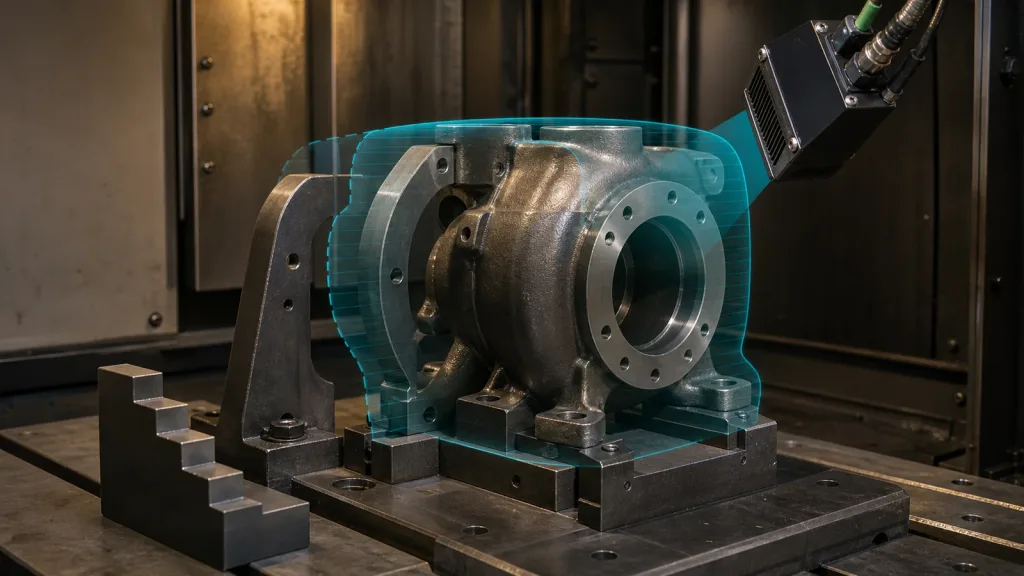
For a real buyer, a High sensitivity 3D depth sensor is not defined by a slogan. It is defined by whether a useful edge change in the protected target still creates a dependable depth change after the scene gets harder. NIST's April 27, 2026 paper on depth resolution for 3D sensors is useful here because it treats depth resolution as the smallest physical depth change that causes a detectable measured change, and it explicitly ties that capability to noise on the specific target being measured. That is the right mindset for dark totes, matte plastics, and soft-edged cable bundles.
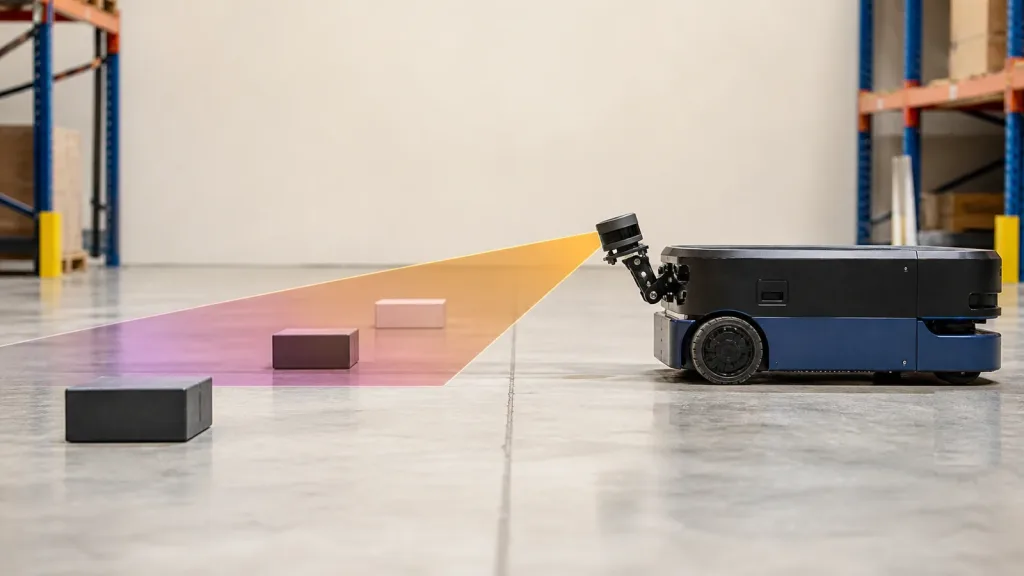
Current industrial SPAD guidance points in the same direction. Sony's current SPAD ToF industrial overview explains that SPAD pixels can detect low levels of light and are designed to improve distance resolution even on low-reflectivity distant objects. That is category-level evidence, not a claim about the MRP-LD1 itself. But it tells buyers what "sensitivity" should mean in practice: not a prettier marketing number, but a better chance of preserving useful depth on weak-return targets.
The 2025 paper Performance Bounds of Ranging Precision in SPAD-Based dToF LiDAR adds another important warning. It shows that photon flux and pile-up affect achievable ranging precision, which means a setup that looks stable in one optical condition may degrade when the scene or light balance changes. A buyer should therefore validate the target in the same mixed scene that will exist on the machine, not on an isolated bench object.
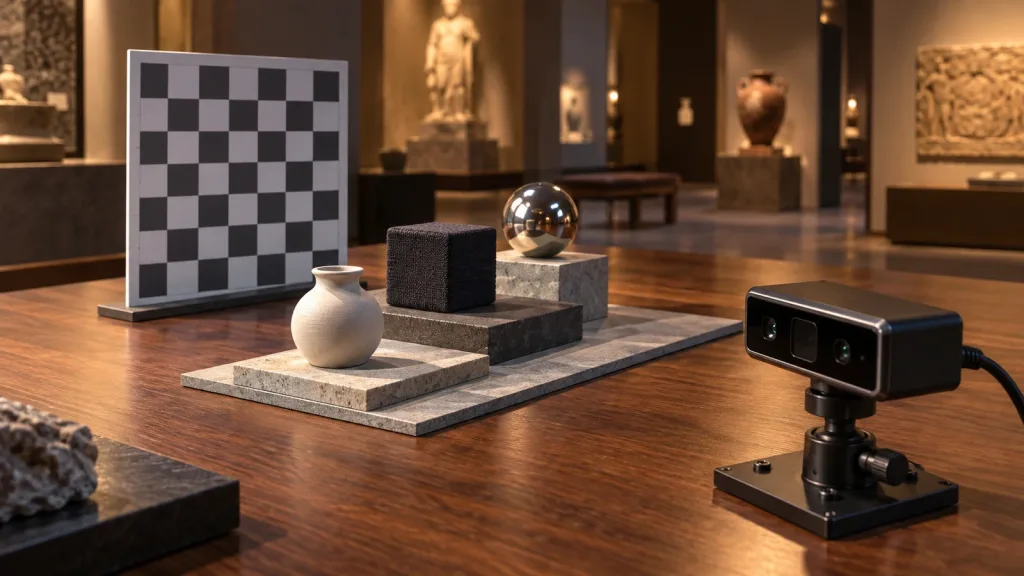
Sensitivity testing also has to include the opposite failure mode: bright interference beside the dark target. The 2026 paper Ghosts in the Point Clouds shows how compact solid-state arrays can create glare-driven artifacts around bright or retroreflective surfaces. In a workcell, that translates into a practical question: can the module still hold the dark tote rim or black-plastic seam when a white label, metal guide, or reflective bracket shares the frame?
Decision table for weak-return scene approval
| Evaluation area | What to test | Approve if | Reject if |
|---|---|---|---|
| Dark-target retention | Can the module keep the tote rim, dark tray wall, or matte part face readable at the real stand-off distance? | The target edge remains consistently visible across repeated passes. | The target disappears or moves only because the surface is dark or weak-return. |
| Low-contrast edge stability | What happens when two nearby surfaces have similar color or reflectivity? | The system still separates the decision edge well enough for the workflow. | The decision depends on guessing where the edge should have been. |
| Mixed-scene behavior | How does the target behave when a white card, glossy label, or metal bracket sits nearby? | The dark target remains interpretable and repeatable in the mixed scene. | Bright neighbors create unexplained shifts, ghosts, or dropouts around the protected edge. |
| Coverage fit | Does the mounted 60 degree x 45 degree field of view fully cover the real target zone? | The sensor sees the decision edge from the mount the machine can actually keep. | The sensor works only when mounted at a lab angle the production machine will not use. |
| Replayable evidence | Can the team review depth and transport data from the same failed pass later? | Another engineer can understand whether the failure came from scene, optics, transport, or parsing. | The decision depends on someone remembering what the live preview seemed to show. |
| Approval discipline | Did the team freeze targets, lighting states, and pass-fail rules before comparing runs? | The comparison remains fair enough for procurement and engineering to trust. | The "best" result changes because the setup drifted, not because the module solved the task. |
Exact featured-product facts to test before approval
The current Featured WooCommerce product for this workflow is the LiDAR Drone Module - MRP-LD1 Solid-State dToF Sensor. The table below keeps the evaluation inside verified product truth while translating those facts into weak-return validation questions.
| Parameter | Published value | Validation implication |
|---|---|---|
| Ranging principle | dTOF | Judge the module on time-based depth behavior in the protected zone, not on a single pass/fail trigger. |
| Scanning principle | SPAD | Use weak-return and mixed-brightness scenes to test whether sensitivity holds on the real target. |
| Core advantage in the brief | Single-photon sensitivity | Demand evidence that dark targets stay readable instead of assuming the phrase guarantees success. |
| Range | Indoor 0.5-25m / outdoor 0.2-8m | Translate the range into the actual workcell stand-off distance where the protected edge matters. |
| Ambient-light resistance | 80Klux | Still test with the workcell's real light leaks, bright labels, and reflective neighbors. |
| Accuracy | 0.2-1m <= +/-3cm; 1-5m <= +/-5cm; 5-8m <= +/-10cm; 8-15m <= +/-20cm | Set pass-fail tolerances around the tote rim, clip edge, or keep-out line your machine must actually interpret. |
| Field of view | 60 degrees (H) x 45 degrees (V) | Check whether one mount covers the dark target and its bright neighbors without creating blind edge decisions. |
| Output | 40 x 30 at 10fps | Verify that this grid is sufficient for the protected edge and the speed of the handoff decision. |
| Interfaces | UART / UVC / UDP | Pick one logging path early enough that the same failure can be reviewed after the run. |
| Software support | Windows / ARM / Linux / Android | Prototype fast, but preserve at least one host path the program can keep after approval. |
| Power / weight | 5V, 1.2W, 8g | Useful for compact mounts, but compactness does not prove dark-target performance. |
| Application scope | Robotics, UAV obstacle avoidance, AR/VR, industrial inspection, and security | Use the article's workcell case as one realistic validation path inside the approved application scope. |
A practical validation workflow for dark targets and low-contrast edges
1. Define one weak-return decision before you power the sensor
Start with one decision the machine must get right: detect that a matte-black tote reached the stop line, confirm that a dark cable bundle is present inside the nest, or hold a low-contrast tray edge long enough for the next station to trust the handoff. If the target is still vague, review Purpleriver's compact dToF evaluation workflow first, then narrow the task to the one edge that should govern approval.
2. Build a mixed-albedo target set instead of a clean demo scene
Weak-return validation is incomplete if every target is dark and every neighbor is dark. Use the real matte or low-gloss target, then place a bright card, white label, metal guide, or polished fastener near the protected edge. That combination is where false confidence usually appears. A sensor that reads the dark tote only when the scene is optically polite is not ready for a workcell.
3. Capture both the simple preview and the engineering evidence
Keep the workflow easy enough for quick review, but never stop there. Use Purpleriver's guides to visualizing dToF depth data, depth map versus point cloud, and evaluating a point-cloud dataset so the team can compare what the live view suggested against what the captured data actually preserved.
4. Freeze one interface and one logging path before comparison runs
Switching between UART, UVC, and UDP during evaluation makes failure analysis worse. Decide which path gives the cleanest evidence first, then keep it fixed through the comparison. If the team still needs that tradeoff framed, use Purpleriver's UART, UVC, or UDP guide before the first serious validation pass.
5. Change the light and the neighbor, not the rule
After the first pass, keep the mount and pass-fail rule fixed while you change only the scene difficulty. Add a white label to the tote, rotate the dark part slightly, let the bench light spill in from one side, or move a metal bracket closer to the protected edge. The goal is not to make the sensor fail for sport. The goal is to learn whether sensitivity on the real target is stable enough to trust.
6. Approve only if the failure is replayable
A team should be able to take one bad pass and explain whether the loss came from target reflectivity, edge geometry, scene glare, transport, or host parsing. If that explanation depends on memory instead of logs, the module is still in demonstration mode, not pilot-ready mode.
Interface, data, and replay planning
The brief includes technical-support details that are directly useful for validation. They matter here because a weak-return problem is easy to misdiagnose when the transport path is unclear or the team changes data modes in the middle of testing.
| Integration topic | Verified brief fact | Approval question |
|---|---|---|
| UART bring-up | UART should use 921600 or 460800, 8N1, no parity, and no flow control. | Can the team capture the weak-return run without transport confusion before arguing about optics? |
| UVC mode choice | 40 x 30 outputs depth, 160 x 120 outputs point cloud, 120 x 90 outputs mixed data, and 480 x 360 outputs full data. | Which mode best preserves the tote rim or low-contrast edge your review actually cares about? |
| UDP archive path | Each UDP sensor-data frame is 4873 bytes, with a 73-byte header and 4800-byte pixel payload. | Can the host archive enough raw evidence that the same failed pass can be re-parsed later if needed? |
| Time alignment | UART can output PPS millisecond offset, and UDP mode supports TCP time sync on port 8081. | Can the team line up the sensor output with the tote motion or station event that triggered the decision? |
| Host support | Documented support includes Windows, ARM, Linux, and Android. | Is the chosen evaluation host close enough to the real deployment path that the evidence will still matter after approval? |
If the low-return scene still looks inconsistent after the transport choice is fixed, use Purpleriver's guide to common LiDAR integration issues before concluding that the optics alone are at fault.
Realistic application case: dark tote and cable-harness confirmation in a kitting workcell
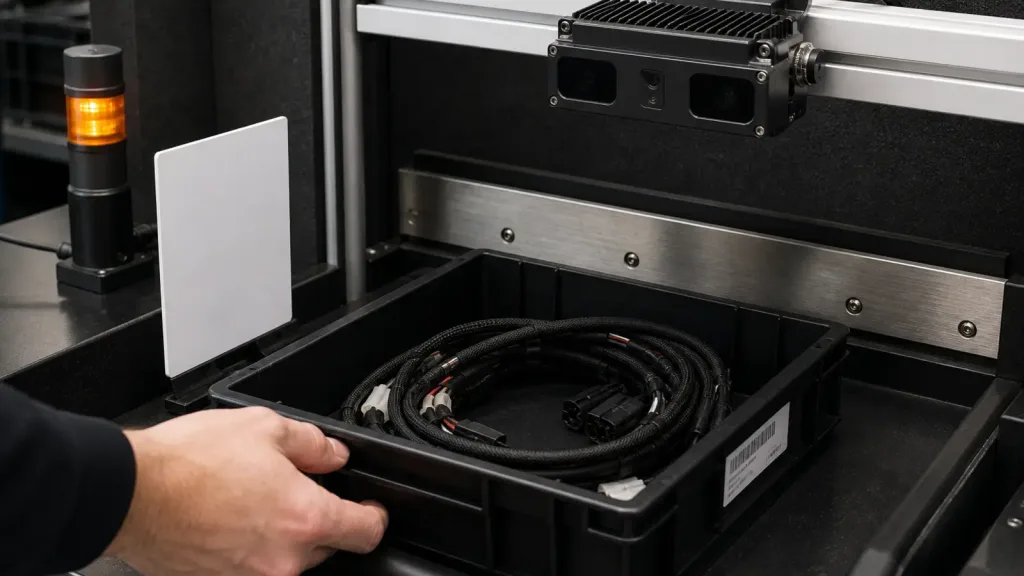
Consider a compact station that verifies whether a matte-black tote carrying a dark cable harness has arrived correctly before a pick-and-place handoff. The tote sits in a charcoal foam nest under an aluminum crossbar. A white setup card is clipped to one side of the station for alignment checks, and a brushed metal guide rail sits along the far edge of the nest. That means the protected edge is weak-return, but bright neighbors are always present.
The team's real question is narrow: can the module keep the tote rim, harness silhouette, and stop-line edge readable enough that the cell can trust the arrival decision without forcing a human to re-check every ambiguous pass?
- Mount the module at the exact height and pitch the crossbar can keep in production.
- Run the tote empty, then with the dark harness, then with the same harness plus a bright white label on the tote wall.
- Capture one fixed interface path for every run so the comparison stays fair.
- Repeat the same sequence with the side light brighter and dimmer, but without moving the mount or changing the pass-fail edge.
- Reject the setup if the protected tote rim becomes arguable as soon as the bright neighbor enters the frame or the light shifts slightly.
This case stays inside the MRP-LD1's documented industrial-inspection and robotics scope while focusing the sensitivity question on one workcell decision instead of on a vague promise of "better depth."
Common mistakes
- Approving the sensor on a bright target board before any dark or low-contrast target enters the scene.
- Testing only dark objects and never placing a bright or reflective neighbor near the protected edge.
- Moving the mount, the interface, and the lighting at the same time, then trusting the result anyway.
- Assuming "single-photon sensitivity" guarantees the workcell decision without target-specific evidence.
- Treating a clean live preview as proof when no replayable data path exists.
- Using compact size and low power as a substitute for dark-target validation.
RFQ and approval checklist for weak-return scenes
| Checklist item | Why it belongs in the approval gate |
|---|---|
| Named protected edge | Keeps the evaluation tied to one real machine decision instead of a generic demo. |
| Dark target sample set | Shows whether the weak-return surface itself is stable enough for the job. |
| Bright-neighbor challenge | Reveals whether nearby labels, rails, or metal parts disturb the protected edge. |
| Frozen mount geometry | Prevents the team from winning the test with a lab-only angle. |
| Single interface path | Keeps the replay evidence consistent from run to run. |
| Captured failure example | Lets another engineer verify why the target was lost or shifted. |
| Pass-fail tolerance | Turns depth quality into a decision rule procurement can actually use. |
| Named next-step owner | Clarifies whether the follow-up belongs to optics, firmware, parsing, or mechanical integration. |
When a compact high sensitivity 3D depth sensor is actually ready for approval
The module is ready only when the dark target stays readable, the mixed scene stays explainable, and the evidence survives replay. Until then, the team does not have a reliable workcell sensor decision. It has a promising demo.
If your program needs to validate a compact SPAD dToF module against a specific low-return scene, use Purpleriver's contact page and include the target material, stand-off distance, mount geometry, and failure case you need to prove.