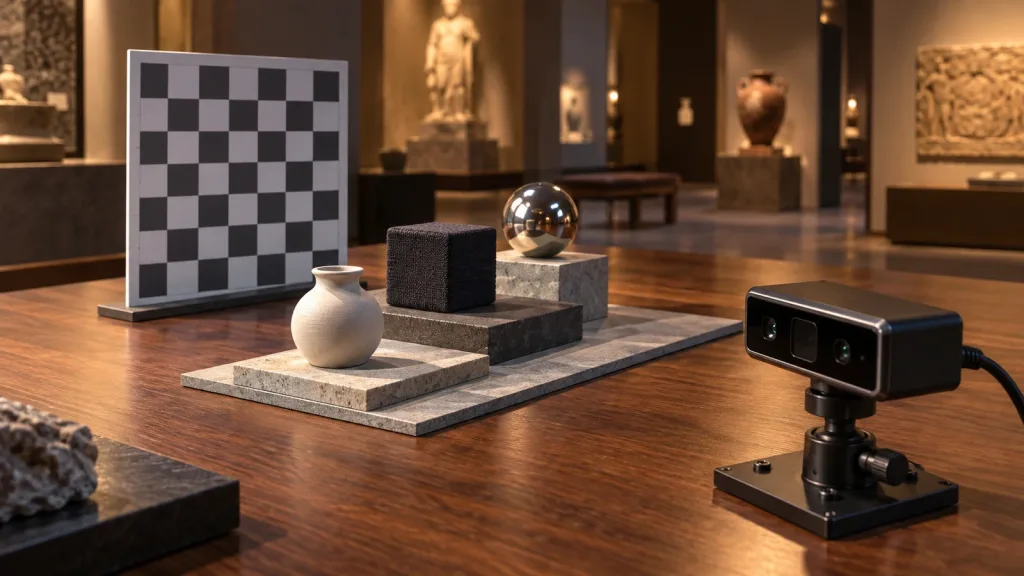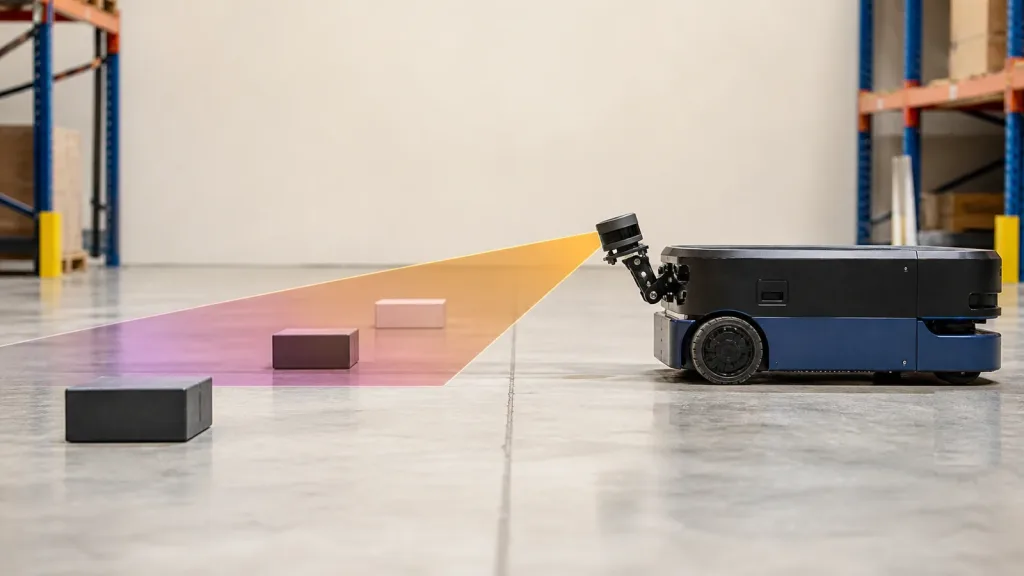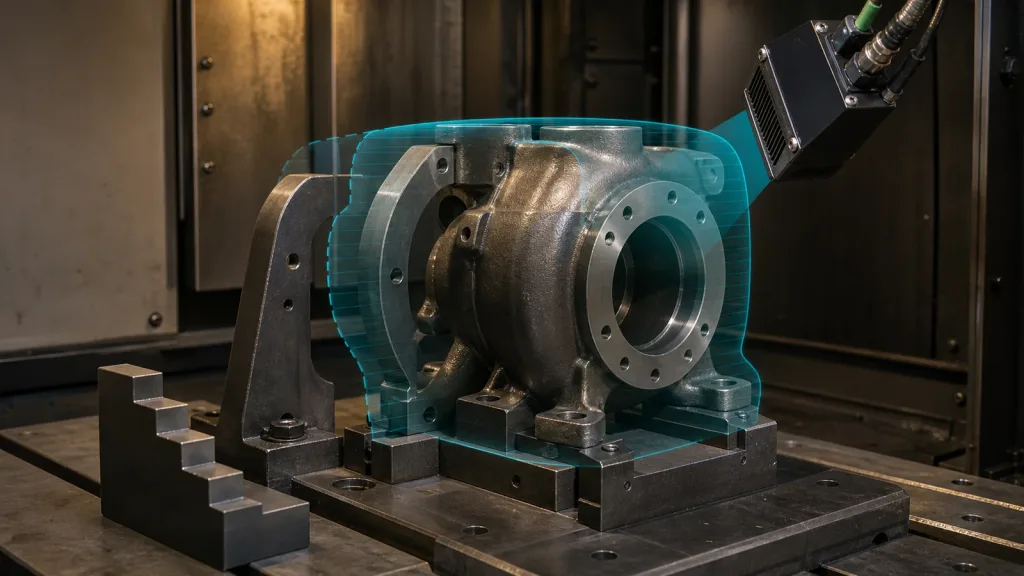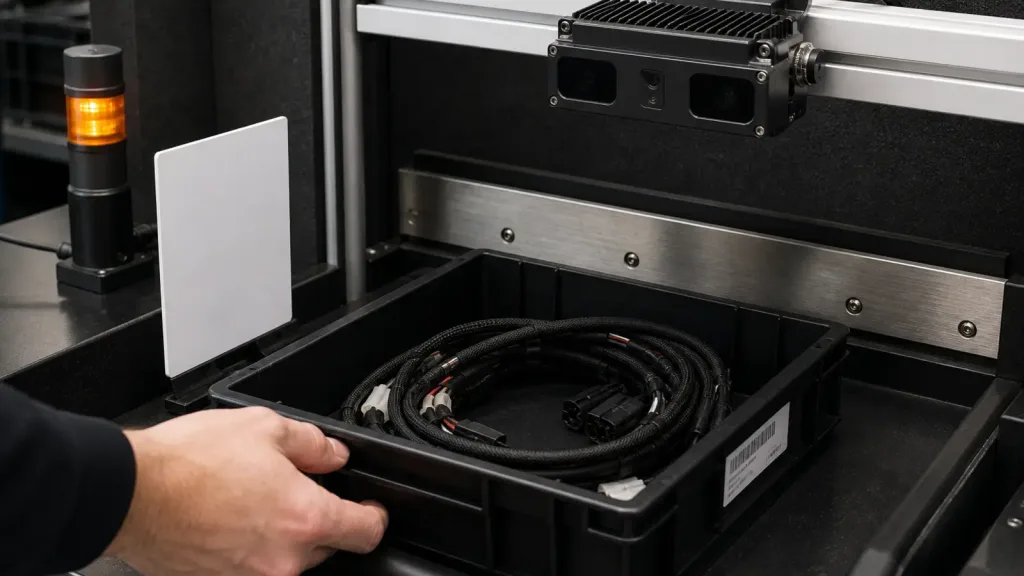
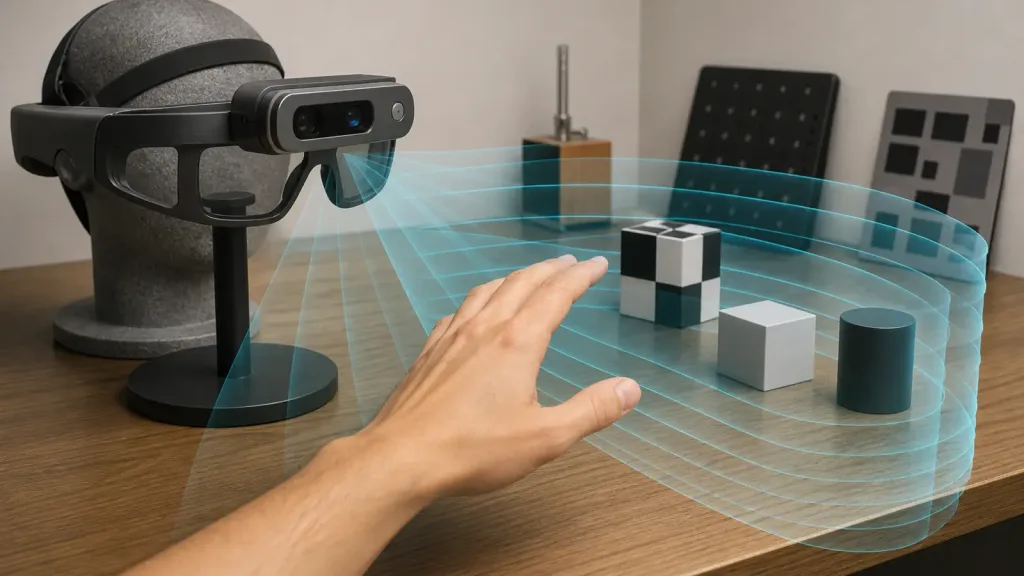
AR VR depth dToF module looks attractive the moment a prototype team decides it needs real depth instead of another monocular demo. The failure point is usually not deciding that depth matters. It is assuming a compact module can already satisfy near-field gesture checks, desk-edge awareness, mounting limits, and host-side replay without a tighter screening pass.
Purpleriver's Featured product already lists AR/VR in its application scope, but that does not remove the need for prototype validation. For an AR/VR concept, the real question is whether the module's field of view, resolution, interfaces, and indoor operating window are good enough for the near-field scene you actually need to test.
| Quick answer | Shortlist an AR VR depth dToF module only after you verify near-field scene fit, gesture reach coverage, host-side evidence flow, and mechanical mounting constraints. The module can be promising without being automatically prototype-ready. |
|---|---|
| Best fit | AR/VR prototype leads, embedded perception engineers, and technical buyers exploring compact 3D sensing for room-aware accessories, tabletop demos, or wearable experiments. |
| Main risk | Treating an AR/VR application label as proof of prototype fit before checking near-field FoV, output format, and practical bench behavior. |
Why AR VR depth dToF module screening is different
Current authoritative vendor material makes one point clear: compact dToF depth sensing is now discussed in mobile, wearable, and AR/VR contexts because it can provide distance, confidence, and scene information in a small optical package. That still does not answer the harder prototype question: is the shortlisted module good enough for your near-field interaction scene?
For AR/VR teams, the weak assumption is usually that any compact depth module can bridge the gap between a tabletop demo and a usable wearable concept. In reality, near-field prototypes are sensitive to field of view, edge visibility, output format, physical placement, and how quickly the team can replay depth data on the real host. If you need supporting basics before this application-specific article, Purpleriver's guides on depth maps versus point clouds and LiDAR terms are useful refreshers.
The right first question is not, "Can this module be used for AR/VR?" The better question is, "What near-field evidence can this module produce on my gesture, object, and mounting scene before I approve the next prototype step?"
| Prototype question | What the application label answers | What still needs proof |
|---|---|---|
| AR/VR relevance | The module belongs in the conversation for compact depth sensing. | Whether the actual near-field interaction scene fits the module's FoV and output density. |
| Indoor depth behavior | You know the shortlisted module is intended for structured depth measurement, not only binary proximity. | Whether desk edges, hands, and small nearby objects remain legible enough for your prototype goal. |
| Mechanical fit | The compact size and weight may look promising on paper. | Whether the mounting position, cable path, and enclosure shape still work on your rig or accessory concept. |
| Host-side progress | You know which interfaces are available. | Which path gives your team replayable depth evidence fastest on the actual prototype host. |
| Prototype confidence | You can say the module is an AR/VR candidate. | Whether the module produces enough scene evidence to justify the next build step instead of another general demo. |
What the MRP-LD1 facts mean for AR/VR work
Purpleriver's Featured product is the LiDAR Drone Module - MRP-LD1 Solid-State dToF Sensor. The table below uses only the supplied Featured-product export and translates those facts into near-field prototype questions rather than unsupported headset claims.
| Featured-product fact | Exact value | Prototype implication |
|---|---|---|
| Ranging principle | dTOF (Direct Time-of-Flight) | The module belongs in a real depth-sensing prototype shortlist rather than a generic proximity bucket. |
| Scanning principle | SPAD (Single-Photon Avalanche Diode) | The depth path is built for measured distance, but scene usefulness still depends on output and target behavior. |
| Emitter wavelength | 940nm VCSEL | This supports compact dToF architecture; it does not by itself prove near-field AR/VR fit. |
| Laser safety | Class 1 (FDA Recognized Eye-Safe) | Useful for screening, but it does not replace your own enclosure, placement, or prototype review. |
| Range | Indoor 0.5-25m; outdoor 0.2-8m | The important AR/VR question is whether your near-field scene sits comfortably inside the useful indoor window. |
| Ambient-light resistance | 80Klux | Helpful when prototypes move between controlled indoor light and brighter mixed environments. |
| Accuracy | 0.2-1m <= +/-3cm; 1-5m <= +/-5cm; 5-8m <= +/-10cm; 8-15m <= +/-20cm | Your prototype should map its critical reach and object distances against the accuracy window you actually care about. |
| FoV | 60 degrees (H) x 45 degrees (V) | This is a key near-field screening fact because it shapes how much hand motion, desk edge, or nearby geometry you can capture at once. |
| Resolution / frame rate | 40 x 30 at 10fps | Good enough for some coarse prototype questions, but not a substitute for assuming dense room-scale reconstruction. |
| Interfaces | UART / UVC / UDP | The best prototype path is the one that gets depth evidence onto your preferred host fastest. |
| Software support | Windows / ARM / Linux / Android | This widens who can inspect the first prototype data without waiting for a single custom platform. |
| Power / weight | 5V, 1.2W, 8g | These are useful early filters when a concept needs a small add-on rig or lightweight mount. |
A realistic prototype case
A product team is not building a finished headset yet. It is trying to answer a narrower question first: can a compact depth module help a visor-style or accessory prototype tell the difference between a reaching hand, a tabletop edge, and a nearby object cluster in a controlled indoor scene?
That is a good use of an AR VR depth dToF module article because it forces the team to define the first proof run. Does the field of view cover the near-field scene? Can the output be replayed quickly enough to compare hands and objects? Is the module small and light enough to mount on a temporary frame without creating a mechanical dead end? Those are prototype questions. They are more useful than asking whether the module sounds advanced.
If the first prototype cannot answer those questions with replayable data, the next build step should wait. The cost of a sample is not only hardware. It is also the time a team spends proving a scene that the shortlist never defined well enough.
Interface, depth output, and host fit
A compact AR/VR prototype lives or dies on how fast a team can inspect depth output. For the MRP-LD1, Purpleriver lists UART, UVC, and UDP, which creates several proof paths. If the goal is quick near-field inspection, visualizing dToF depth data for early product testing and the guide on choosing the right LiDAR interface are the most relevant internal resources before a sample arrives.
Prototype teams should also decide whether the first pass belongs on a PC, an embedded Linux board, or a mobile-like host. If you need a lightweight embedded check, Purpleriver's walkthrough on integrating a dToF module with Raspberry Pi and Linux is a practical next step.
The deeper point is simple: an AR VR depth dToF module should be evaluated as a host-and-scene system. Vendor material highlights confidence data, hand contour visibility, and compact wearable relevance. Your bench test should confirm whether those ideas survive your real mounting position, object spacing, and host pipeline.
What current authoritative sources suggest prototype teams should verify
- From ams OSRAM: compact dToF depth sensing for wearables is valuable only if the prototype can use the module's distance and scene outputs meaningfully.
- From ST: hand and finger contour visibility matters because near-field AR/VR checks often fail on edges and reach geometry before anything else.
- From recent SPAD flash LiDAR research: AR/VR goals can demand more scene detail than a compact shortlist module may provide, so assumptions about resolution must stay explicit.
- From your own prototype workflow: decide whether the first success criterion is gesture reach, tabletop geometry, small-object separation, or host-fit speed, and test that first.
Common prototype mistakes
- Assuming AR/VR mention in a product story automatically means the module fits your near-field prototype.
- Ignoring field-of-view and zone-density limits while expecting dense room understanding from a compact starter module.
- Skipping host-side replay checks and discovering too late that the fastest path to evidence was never chosen.
- Using one broad demo scene instead of defining the specific hand, object, and desk-edge problem the prototype must solve.
- Over-reading product truth. The Featured export supports AR/VR relevance, not a guarantee that every headset or gesture use case is already solved.
RFQ checklist before a build starts
- Define the first prototype question precisely: hand reach, object separation, desk-edge awareness, or room-corner context.
- Map the intended interaction distance against the module's supplied indoor range and accuracy windows.
- Check whether the FoV is large enough for the near-field scene without assuming it will cover more than it does.
- Choose the fastest replay path for your team:
UVC,UART, orUDP. - Decide who will inspect the first data and on which supported host platform.
- Confirm the temporary mount can carry an 8 g module and 5 V / 1.2 W power path without distorting the prototype.
- Request sample evidence that resembles your near-field scene instead of only a generic 3D demo.
- Keep the prototype goal narrow enough that a failed test tells you exactly what to change next.
Need a compact depth module to screen for the next prototype pass?
If your team is evaluating an AR VR depth dToF module, begin with the exact Featured-product facts and a small, replayable near-field scene. Review the MRP-LD1 product page and the documentation resources before you turn a general idea into a build request.