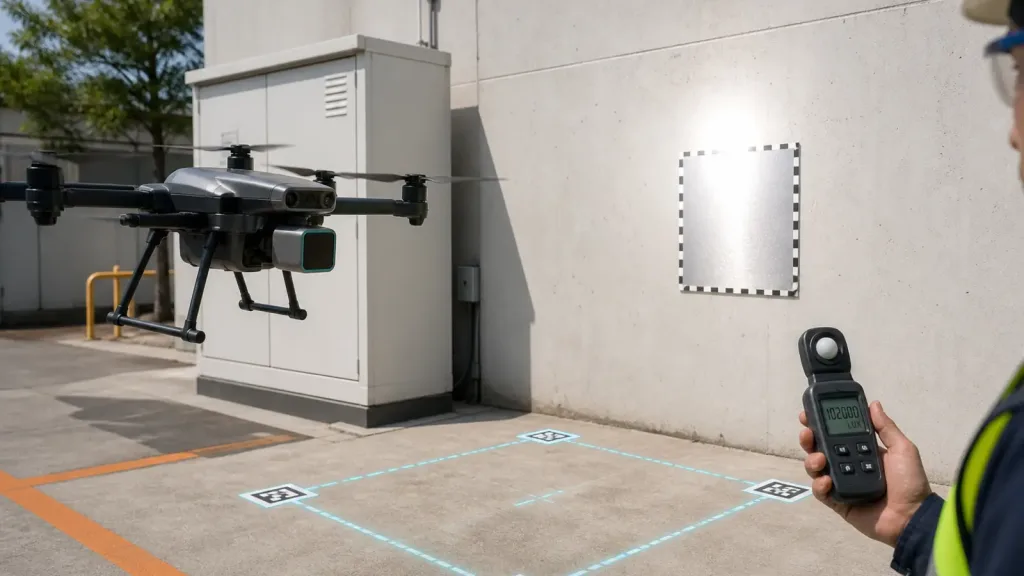
Anti-ambient light LiDAR is one of the easiest claims for buyers to over-trust. A module can look stable indoors, survive a short bench demo, and still become unreliable when direct daylight, pale walls, glossy housings, or reflective safety paint push more background light into the receiver path than the evaluation plan ever captured.
This guide is for technical buyers, UAV integration leads, and robotics teams who need to decide whether a compact dToF module is truly ready for an outdoor or high-glare pilot. The question is not whether the brochure mentions sunlight resistance. The question is whether you can prove useful ranging behavior in the bright scene your project actually has to survive.
| Quick answer | Use an anti-ambient light LiDAR claim only after you validate bright-scene repeatability, reflective-target behavior, and host-side data handoff under measured lighting conditions. |
|---|---|
| Best fit | Teams screening compact dToF modules for outdoor UAV sensing, mobile robotics, or bright industrial yard deployments. |
| Decision rule | If the supplier cannot connect the claim to repeatable test evidence in your geometry, your pilot is not ready for approval. |
What anti-ambient light LiDAR should mean before you approve a module
For a buyer, anti-ambient light LiDAR should not mean “works in sunlight” as a slogan. It should mean the sensing chain still produces usable distance information when background light, scene reflectivity, and host integration constraints get closer to your real deployment. ST positions direct Time-of-Flight sensors for robotics and drones, including obstacle detection, collision avoidance, 3D mapping, and SLAM, while also stressing accurate measurement in a compact integrated system. That is a useful category signal, but it is not a substitute for application-specific proof.
Texas Instruments’ optical front-end note is useful here because it reminds buyers that ambient-light handling is not magic. It depends on design choices in the receive path, including ambient-light cancellation and dynamic-range management. A current SPAD dToF paper from 2026 reinforces the same point from the sensor side: modern architectures are explicitly engineered to operate under high background illumination, which means bright-scene performance is a measurable engineering problem, not a marketing adjective.
NIST’s work on 3D perception standards gives the buyer-side rule that matters most: performance has to be understood with industry-accepted metrics and tests. That is the right mindset for an outdoor pilot. If the claim is important enough to affect supplier selection, it is important enough to measure.
Anti-ambient light LiDAR decision table for outdoor pilot screening
| Evaluation area | What to verify | Why it matters | Reject if |
|---|---|---|---|
| Bright-scene stability | Range repeatability across measured daylight or plant-light conditions | A single good frame is not enough for a pilot approval decision | The output drifts or collapses when lighting changes within expected operating conditions |
| Reflective-target behavior | Performance on pale walls, glossy panels, painted metal, and mixed surfaces | Outdoor scenes often fail on reflectivity differences before raw range limits | The module cannot maintain useful readings on representative target materials |
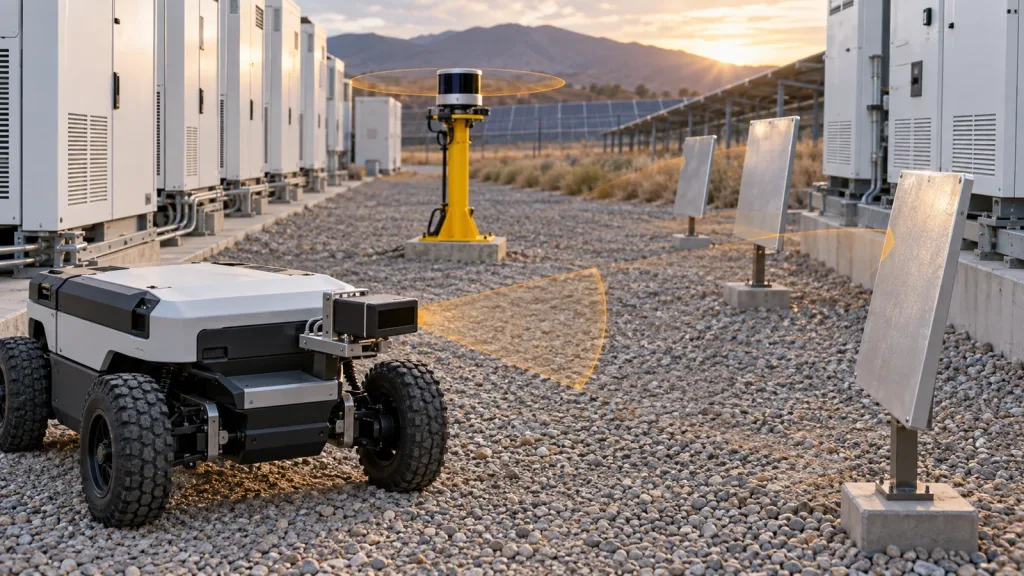
| Coverage geometry | How field of view, mounting angle, and background light interact in the real lane or corridor | Glare and blind wedges are geometry problems as much as sensor problems | Critical obstacles or wall edges disappear at the exact mounting posture you need |
| False-trigger behavior | Nuisance events, unstable edges, and intermittent returns during repeated passes | Pilots fail when teams cannot separate real obstacles from bright-scene noise | No clear acceptance threshold can be sustained over repeated test cycles |
| Host-side evidence | Can you log and replay the raw or processed output through the planned interface? | Without replayable evidence, every bright-scene miss becomes an argument instead of a diagnosis | The team cannot capture enough data to explain a failure after the run |
Exact featured-product facts to validate first
The current Featured WooCommerce product for this workflow is the LiDAR Drone Module – MRP-LD1 Solid-State dToF Sensor. If you are screening it as an anti-ambient light LiDAR option, these are the exact facts you can safely use.
| Parameter | Published value | Evaluation implication |
|---|---|---|
| Ranging principle | dTOF | Plan for timing-based distance evaluation, not a generic proximity-only check. |
| Scanning principle | SPAD | The bright-scene claim must be judged with real signal stability, not only target detection. |
| Emitter | 940nm VCSEL | Window materials, sunlight conditions, and reflective surfaces should all be part of the test scene. |
| Ambient-light resistance | 80Klux | This is the headline claim to verify with measured conditions and repeated trials, not to assume. |
| Range | Indoor 0.5-25m / outdoor 0.2-8m | Translate this into your real stand-off distances instead of quoting the broad range alone. |
| Accuracy | 0.2-1m <= +/-3cm; 1-5m <= +/-5cm; 5-8m <= +/-10cm; 8-15m <= +/-20cm | Use these bands to define pass-fail tolerances for the test lane you care about. |
| FoV | 60° x 45° | Model whether glare sources and obstacle edges stay inside usable coverage at the chosen mount angle. |
| Output | 40 x 30 at 10fps | Confirm that the scene updates and spatial granularity still support your decision logic in bright conditions. |
| Interfaces | UART / UVC / UDP | Pick the interface that makes bright-scene replay and comparison easiest before embedded optimization. |
| Power / weight | 5V, 1.2W, 8g | Useful for lightweight drones or compact robots, but only after the optical claim is proven in context. |
A practical bright-scene validation workflow
1. Define the lighting problem before you mount the module
Write down the scene you actually have: direct sunlight against a pale facade, reflected glare from a white utility cabinet, late-afternoon side light across a service lane, or mixed indoor-outdoor transitions near a warehouse door. If the lighting challenge is not documented in physical terms, the phrase “anti-ambient light” has no useful meaning.
2. Measure the scene, not just the sensor output
Record lighting conditions for each trial, even if you only have a simple lux meter and scene photos. The purpose is not to create a laboratory paper. The purpose is to avoid vague statements such as “it was sunny” or “it looked fine outdoors.” If your supplier claims 80Klux resistance, your test notes should show what the scene actually was when the data passed or failed.
3. Use representative reflective targets
Do not stop at cardboard boxes or matte boards. Test against the materials your pilot will really encounter: painted metal, glossy plastic covers, pale masonry, reflective safety tape, and mixed backgrounds. Bright-scene failures often appear when a wall, cabinet edge, or obstacle creates a range return that is unstable rather than completely absent.
4. Validate geometry and not just distance
A sunlight-resistant claim can still fail operationally if the mount angle, field of view, or background composition causes a blind wedge. Sketch the actual lane or approach corridor. Then mark the floor boundary, wall line, and obstacle envelope that must remain visible. For a drone or compact robot, this matters as much as the raw range number.
5. Capture replayable evidence through the intended interface
The MRP-LD1 supports UART, UVC, and UDP. In early validation, choose the path that gives you the clearest replay and comparison workflow. Purpleriver’s UART, UVC, or UDP guide, the documentation hub, and the sample datasets page are the most relevant internal checkpoints. Once the bright-scene behavior is understood, you can simplify the handoff for deployment.
6. Approve the claim only after repeated passes
A single outdoor success is not approval evidence. Run repeated passes at the same geometry, then vary the angle, target material, and background brightness. If the output becomes unstable or the edge logic breaks when the scene changes slightly, the module is not ready for a confident pilot sign-off.
Interface, data, and proof capture
Bright-scene validation is often lost in the gap between optics and software. Keep the proof path simple and deliberate.
| Integration topic | Questions to answer |
|---|---|
| Scene logging | Can the team store sensor output, scene photos, and measured lighting conditions together for later review? |
| Replay workflow | Can a failed bright-scene pass be replayed frame by frame without rebuilding the entire setup? |
| Decision output | Will the downstream system consume raw depth, a processed point cloud, or a simple event threshold? |
| Mounting repeatability | Can the sensor be re-mounted at the same angle after maintenance or field changes? |
| False-trigger analysis | How will the team distinguish glare-driven instability from a real obstacle event? |
| Debug ownership | Who owns the interpretation of bright-scene failures: perception, controls, or system integration? |
If your team has already struggled with unclear data handoffs, Purpleriver’s guide to common LiDAR integration issues is worth revisiting before the pilot starts.
Realistic application case: bright service yard inspection lane
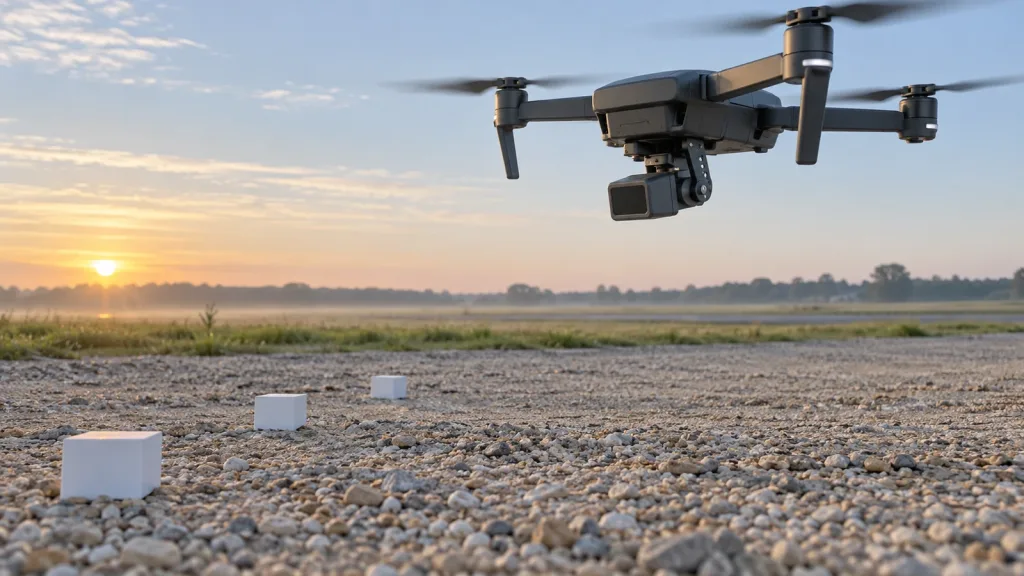
Consider a compact inspection drone or small robot working in a service yard beside a pale concrete wall and a white utility cabinet around midday. The team needs short-range obstacle awareness and stable distance behavior while the vehicle approaches a wall edge, pauses for inspection, and backs away along a painted lane.
A practical evaluation sequence is:
- Mount the module at the real angle and height the platform can support.
- Record the scene lighting and target surfaces before each pass.
- Run repeated approaches and retreats against the same wall edge and cabinet corner.
- Change the angle slightly to see whether glare or blind wedges appear.
- Replay the logs and compare whether the same distance and event behavior holds across passes.
This case fits the Featured product’s published application scope for UAV obstacle avoidance, robotics perception, and industrial inspection without inventing any undocumented product guarantee.
Common mistakes when screening an anti-ambient light LiDAR claim
- Accepting a bright-scene claim without measuring the scene lighting during the test.
- Using matte indoor targets only, even though the pilot will face pale walls, glossy surfaces, or reflective paint.
- Treating a single successful outdoor pass as production-grade evidence.
- Testing range only and ignoring edge stability, nuisance triggers, and blind wedges.
- Choosing an embedded interface too early and losing the ability to replay bright-scene failures clearly.
- Quoting the brochure number instead of defining a pass-fail tolerance for the actual corridor or obstacle geometry.
RFQ and pilot-approval checklist
| Checklist item | Why it belongs in the RFQ or approval review |
|---|---|
| Measured bright-scene test conditions | Prevents “sunlight resistant” from staying a vague marketing phrase. |
| Representative target materials and finishes | Ensures the supplier and buyer are testing the same reflectivity problem. |
| Defined pass-fail range or stability threshold | Turns the claim into an engineering decision instead of a visual impression. |
| Mounting geometry and field-of-view assumptions | Bright-scene failures often emerge from angle and background composition. |
| Replayable logs from the planned interface | Lets the team investigate misses and nuisance triggers after the run. |
| Repeat-pass evidence | Shows that the claim survives more than one favorable scene. |
| Escalation path for unstable bright-scene behavior | Clarifies who owns optics, firmware, host processing, and deployment decisions. |
When a bright-scene claim is ready for a real buying decision
If your team can show measured lighting conditions, repeated pass data, stable geometry coverage, and a replayable host-side workflow, then an anti-ambient light claim is finally becoming useful procurement evidence. If you cannot, the next step is more disciplined validation, not faster purchasing.
Purpleriver’s featured MRP-LD1 solid-state dToF sensor is relevant for teams evaluating compact obstacle sensing and depth perception in robotics, drones, AR/VR, and industrial inspection. To discuss fit for your own outdoor pilot, use the contact page and include the stand-off distance, target materials, mount angle, and lighting conditions you need to validate.