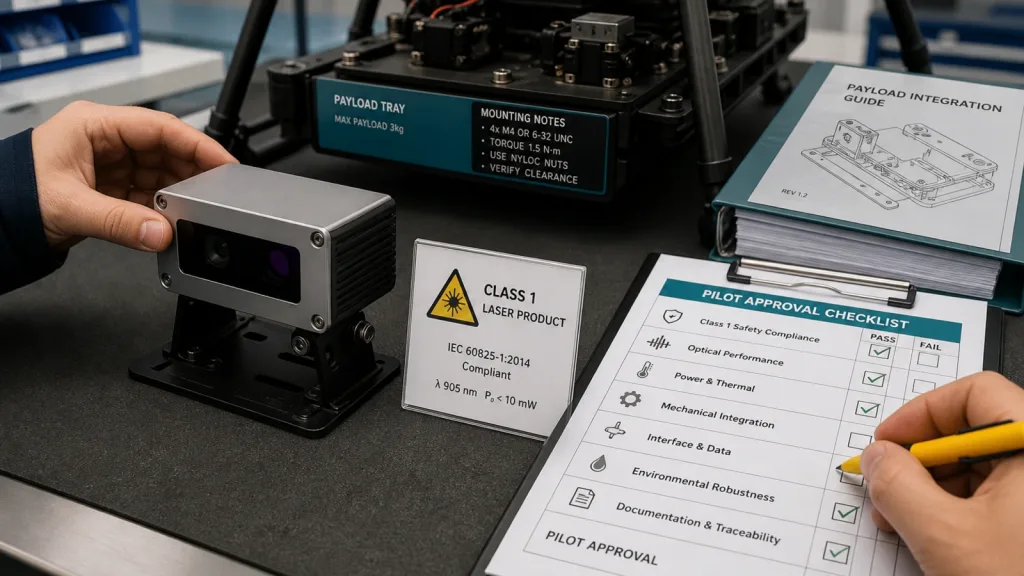
Class 1 eye safe LiDAR is an important screening signal, but it is not a blank check for deployment. Technical buyers often see a Class 1 line in a datasheet, assume the pilot build is already covered, and move straight to brackets, interfaces, and obstacle-avoidance demos. That shortcut is risky because laser class, labeling scope, mounting context, and hosted-system behavior are not the same question.
If your team is reviewing a compact module for a UAV, robot, or industrial pilot, the right question is narrower and more useful: what does the Class 1 claim actually prove, what remains the host integrator's responsibility, and what evidence should be approved before the module is cleared for a real pilot build?
| Quick answer | Treat a Class 1 eye safe LiDAR statement as necessary but incomplete. Verify the labeling basis, whether the item is a complete product or a component, the intended mounting geometry, and whether the pilot host still preserves the conditions assumed by the safety claim. |
|---|---|
| Best fit | Sourcing engineers, technical buyers, UAV integration leads, and robotics teams reviewing compact dToF modules before pilot approval. |
| Decision rule | Approve only when the supplier can show clear Class 1 documentation, the host-build context is understood, and the team has checked integration evidence instead of relying on a single marketing phrase. |
What a Class 1 eye safe LiDAR claim actually means
The FDA's current laser-product guidance is the cleanest place to start because it maps FDA Class I to IEC Class 1 / 1M and describes Class I products as considered non-hazardous in normal use, with extra caution when optical aids are involved. That is useful, but it does not mean every future installation, bracket, housing, or host arrangement is automatically cleared just because the module carries a Class 1 statement.
The regulatory text matters here. The current 21 CFR 1040.10 language distinguishes complete laser products from products sold as components to another electronic-product manufacturer. For buyers, that is a practical warning: a compact LiDAR module may be safe and well-documented as supplied, but the final hosted system still needs review in the context of how the module is mounted, shielded, accessed, and serviced.
The IEC 60825-1 standard scope reinforces that the class statement belongs to laser-product safety classification. It is not a general proof that the module is already appropriate for every pilot build. In other words, a Class 1 claim tells you something important about laser-hazard classification. It does not, by itself, prove pilot readiness, obstacle-avoidance readiness, mechanical suitability, or host-side integration quality.
That distinction matters because buyers often combine several independent approval questions into one. Purpleriver already covers sample-request screening, interface selection, and integration diagnostics. This article focuses only on the laser-safety interpretation step inside that broader workflow.
| Review gate | What to verify | Reject or escalate if |
|---|---|---|
| Class meaning | The supplier can point to a clear Class 1 or equivalent statement and explain the intended normal-use context. | The class language is vague, inconsistent, or detached from the actual shipped module. |
| Component versus full product | The team knows whether it is buying a standalone labeled product or a component for embedding into a larger system. | The buyer is treating a component declaration as full hosted-system clearance. |
| Host-build context | Bracket, housing, field of view, access path, and service exposure are reviewed for the pilot build. | The pilot geometry changes the emission path or access assumptions but no review is documented. |
| Documentation package | The supplier provides the relevant label, instructions, and technical notes needed for safe installation review. | The team has only a web-page bullet point and no usable approval package. |
| Pilot readiness | Safety interpretation is kept separate from host integration, depth performance, and obstacle-avoidance evidence. | The class claim is being used as proof that the whole pilot design is ready. |
How to read the MRP-LD1 facts correctly
The current Featured product for this workflow is the LiDAR Drone Module - MRP-LD1 Solid-State dToF Sensor. The table below uses only exported product facts. The goal is to convert those facts into approval questions instead of overstated conclusions.
| Verified product fact | Published value | What a buyer should ask next |
|---|---|---|
| Ranging principle | dTOF (Direct Time-of-Flight) | What host-side test plan confirms the module is being used in the same operating context assumed by the supplied documentation? |
| Scanning principle | SPAD (Single-Photon Avalanche Diode) | What installation notes or handling constraints matter when the module is mounted into the pilot bracket? |
| Emitter | 940nm VCSEL | Where is the emission path relative to exposed operators, service access, and any optical windows in the final pilot build? |
| Laser safety | Class 1 (FDA Recognized Eye-Safe) | Is this claim documented for the supplied module, and what assumptions about normal use, access, and mounting sit behind it? |
| Range | Indoor 0.5-25m; outdoor 0.2-8m | Does the pilot use case keep the module in the same practical stand-off band where the supplier expects it to operate? |
| Ambient-light resistance | 80Klux | Will the pilot place the module near skylights, bay doors, or reflective surfaces that deserve an additional check? |
| FoV | 60 degrees (H) x 45 degrees (V) | Does the mechanical mount preserve the intended field of view without exposing an unexpected angle or service path? |
| Resolution / frame rate | 40 x 30 at 10fps | Has the team separated safety approval from the separate question of whether this output is enough for the pilot task? |
| Interfaces | UART / UVC / UDP | Which interface will the pilot use, and where will logs, configuration, and service access actually happen? |
| Software support | Windows / ARM / Linux / Android | Which host environment owns the pilot, and does the approval package follow that environment? |
| Power / weight | 5V, 1.2W, 8g | Will the pilot bracket or payload tray change orientation, exposure, or service access in a way that needs review? |
A practical verification workflow before pilot approval
1. Confirm whether you are reviewing a module or a complete finished laser product
This is the first buyer checkpoint because it affects every other question. If the item is a component headed into a larger UAV, robot, or industrial enclosure, the team should document who owns the hosted-system review instead of assuming the supplier's line item closes the issue.
2. Request the actual safety and installation documents early
Do not wait until mechanical integration is almost finished. The approval packet should include the relevant labeling context, supplied instructions, and any handling or access assumptions that the host team needs to preserve. If the only evidence is a product-page phrase, the review is still incomplete.
3. Map the claim to the real pilot geometry
OSHA's current laser-hazard guidance describes Class 1 systems as incapable of producing damaging radiation levels during normal operation. The practical phrase is during normal operation. Buyers should therefore review how the module is aimed, bracketed, enclosed, and serviced in the real host build. A compact module on an open test rig, for example, is not the same situation as a module inside a finished payload assembly.
4. Keep safety review separate from application-performance review
A compact module can be correctly classified and still be a poor match for the pilot task. The Class 1 review should not replace the separate checks for host interfaces, obstacle-avoidance logic, environmental behavior, or data quality. This separation prevents teams from passing a pilot build just because one safety field was present.
5. Record the owner of every unresolved question
Good approval reviews name the owner of each issue. If the question is about labeling or class basis, it belongs with the supplier and compliance reviewer. If it is about bracket geometry or service access, it belongs with the host mechanical team. If it is about logs or control behavior, it belongs with the integration team. Mixed ownership is where unsafe shortcuts usually appear.
| What to log | Why it matters |
|---|---|
| Exact module part and label references | Prevents the team from approving one document set for a different item or revision. |
| Mounting orientation and access path | Shows how the real pilot geometry relates to the assumptions behind normal operation. |
| Host enclosure or bracket state | Clarifies whether the module is exposed, partially shielded, or installed as intended. |
| Service and maintenance touch points | Identifies whether servicing could create a different exposure context from normal operation. |
| Interface and host environment | Keeps the approval path tied to the actual Windows, ARM, Linux, or embedded pilot stack. |
Mounting, host, and interface review
The integration review is where buyers often lose discipline. A module can be light, compact, and well specified, yet still need careful review once it is placed into a UAV nose section, a robot mast, or a test bracket that changes operator access. The approval discussion should therefore include the exact host path, not just the module itself.
That is also why interface planning belongs in the same conversation. If the pilot uses UART, UVC, or UDP in a bench environment that differs from the final host, document that difference now. Purpleriver's documentation hub and contact path are useful only when the team already knows which host, bracket, and service context it is trying to approve.
A simple rule helps here: never let the words Class 1 eye safe LiDAR close a discussion about host-path geometry, service exposure, or application readiness. Those are separate sign-off lines and should stay separate in the pilot file.
Realistic application case: compact module review before a UAV pilot build
A UAV integration team is screening a compact dToF module for a short-range obstacle-sensing pilot. The supplier package includes a Class 1 statement, product dimensions, interface options, and example applications. The team's mistake would be to read the class line, mount the module on an open nose bracket, and assume the review is finished.
- Confirm whether the supplied module documentation applies to the exact item and revision being reviewed.
- Review the pilot bracket and access path to see whether the hosted geometry still matches the intended normal-use context.
- Document where operators, technicians, and service steps interact with the mounted module during bench work and field work.
- Keep a separate pilot checklist for host performance, logging, and obstacle-response evidence.
- Approve only when the safety interpretation and the pilot-performance review are both complete.
This case is useful because it shows the real approval sequence. A class claim is one gate in a broader pilot workflow, not the workflow itself.
Common mistakes
- Treating a Class 1 statement as proof that the entire hosted pilot system is automatically approved.
- Failing to distinguish a module or component review from a complete finished laser-product review.
- Skipping the real bracket, enclosure, or service-access review because the module looked safe on the bench.
- Using one product-page sentence in place of the actual documentation needed for internal sign-off.
- Letting laser-safety approval replace the separate checks for interfaces, performance, and obstacle-avoidance behavior.
- Assigning no owner to unresolved questions about labeling scope or hosted-system responsibility.
RFQ and approval checklist
| Checkpoint | Approve only when |
|---|---|
| Class statement is specific | The supplier provides a clear Class 1 basis tied to the actual module under review. |
| Product scope is clear | The team knows whether it is approving a complete labeled item or embedding a component into a larger host. |
| Installation context is reviewed | Bracket, enclosure, access, and service geometry have been checked for the real pilot build. |
| Documentation exists | The team has the relevant instructions and review notes, not just a web-page summary. |
| Host environment is named | The approval packet identifies the planned interface and host platform. |
| Separate pilot-performance review exists | The team has a distinct checklist for depth behavior, control logic, and field evidence. |
| Issue ownership is explicit | Each unresolved item belongs clearly to supplier, compliance, mechanical, or integration review. |
Approve the hosted build, not just the label
A compact module with a valid Class 1 statement is easier to screen than a vague or undocumented option, but pilot approval still depends on mounting, access, host interfaces, and review discipline. Keep the safety gate and the application-performance gate separate so the pilot file stays defensible.
Use the verified MRP-LD1 product page as the product-fact baseline, then send your bracket sketch, intended host path, and pilot-review questions through the contact page if you need a focused sample-review discussion.
Technical guide
FAQ
Common questions and practical answers from this technical guide.
What does Class 1 eye safe LiDAR mean in practice?
It means the product is represented as non-hazardous in normal operation under the assumptions used for its classification. It does not automatically answer every hosted-system question.
Why is the phrase normal operation so important?
Because installation, mounting, or service access can create a context different from ordinary intended use. Buyers should review the real pilot geometry, not just the module on paper.
Is a Class 1 module automatically safe in every UAV or robot build?
No. The hosted system still needs review in the context of enclosure, bracket, field of view, and service access.
Why should buyers care whether the item is a component or a finished product?
Because component and finished-product responsibilities are not identical. Treating one as the other creates approval gaps.
Does a Class 1 claim prove obstacle-avoidance readiness?
No. Eye-safety classification and application performance are different approval questions and should stay separate.
What documents should be requested before pilot approval?
Request the relevant class statement, supporting installation or handling notes, and the exact product references that apply to the supplied module.
Should the team finish the interface plan before approving the sample?
At minimum, the team should know which host environment and interface the pilot will use so the approval path matches the real build.
When should a technical buyer stop and escalate?
Escalate when the class language is vague, the module-versus-system scope is unclear, or the hosted pilot geometry changes the review assumptions.